Yasaka Shrine (八坂神社, Yasaka Jinja), also known as Gion Shrine, is one of the most famous shrines in Kyoto. Founded over 1350 years ago, the shrine is located between the popular Gion District and Higashiyama District, and is often visited by tourists walking between the two districts.
The shrine's main hall combines the honden (inner sanctuary) and haiden (offering hall) into a single building. In front of it stands a dance stage with hundreds of lanterns that get lit in the evenings. Each lantern bears the name of a local business in return for a donation.
Yasaka Shrine is well known for its summer festival, the Gion Matsuri, which is celebrated every July. Arguably the most famous festival in the whole country, the Gion Matsuri dates back over a thousand years and involves a procession with massive floats and hundreds of participants. The shrine also becomes busy during the cherry blossom season around early April, as the adjacent Maruyama Park is one of the most famous cherry blossom spots in Kyoto.
Showing posts with label JAPAN. Show all posts
Showing posts with label JAPAN. Show all posts
Saturday, September 3, 2011

Friday, March 26, 2010
Japan the strange country
Japan-The Strange Country (English ver.) from Kenichi on Vimeo.
This is my final thesis project. I created info-graphic, motion piece. My objective is to make Japanese people to think about that everything happening here in Japan, isn't that normal. So I created this video from foreigner's point of view, rather than Japanese people's point of view.
Both English and Japanese versions are available.
By the way, please don't call me racist, because I am one of short, small eyes Japanese ;P
大学の卒業制作で制作した映像です。(英語版)
日本で生活していると、当たり前すぎて気づかない「不思議な事実」を、海外で生活した経験も生かし、外国人の視点から統計とともに映像化しました。
笑いつつも、「なんか不思議だな」と考えてもらえれば幸いです。
日本語版と英語版があります。
"A journey of a thousand miles must begin with a single step." -- Lao Tzu
Copyright © Demetrios the Traveler
Monday, March 15, 2010
Tokyo Bay, Japan
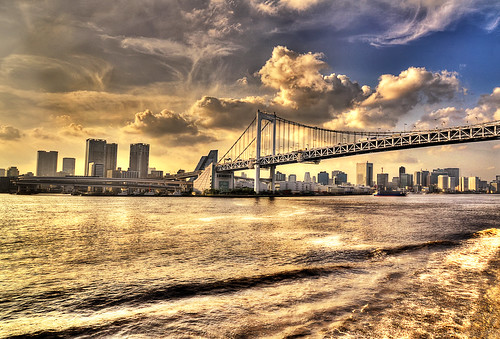
Tokyo Bay (東京湾 Tōkyō-wan?) is a bay in the southern Kantō region of Japan. Its old name was Edo Bay (江戸湾 Edo-wan?).
Tokyo Bay is surrounded by the Boso Peninsula (Chiba Prefecture) to the east and the Miura Peninsula (Kanagawa Prefecture) to the west. In a narrow sense, Tokyo Bay is the area north of the straight line formed by the Cape Kannon (観音崎 Kannon-zaki?) on the Miura Peninsula on one end and Cape Futtsu (富津岬 Futtsu-misaki?) on the Boso Peninsula on the other end. This area covers about 922 km². Tokyo Bay in a broad sense includes also the Uraga Channel. The total area would then be 1320 km².
Tokyo Bay includes about 249 km² of reclaimed land area.
The only natural island in the Bay is Monkey Island (猿島 Saru-shima?), Yokosuka, Kanagawa. There are however many artificial islands that were built as naval fortification during the Meiji and Taishō period.
[edit]Islands
Dream Island (Yume No Shima)
Odaiba
Saru Island (the only natural one)
Heiwa Island ja:平和島
Katsushima ja:勝島
Showa Island ja:昭和島
Keihin Island ja:京浜島
Hakkeijima
Higashi Ogijima ja:東扇島
Tokyo International Airport
Copyright © Demetrios the Traveler

 travel
Sunday, March 7, 2010
Okinawa Churaumi Aquarium, Japan
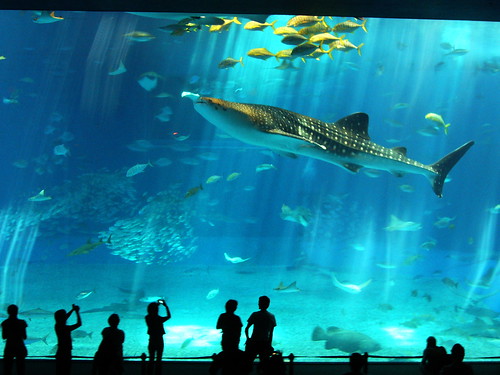
The aquarium is a part of the Ocean Expo Commemorative National Government Park located in Motobu, Okinawa. The aquarium is made up of four-floors which hold attractions of deep sea creatures, sharks, coral and other tropical fish. The aquarium is set on 19,000 m² of land, holds a total of 77 tanks with 10,000 m³ of water. Water for the saltwater exhibits is pumped into the aquarium from 350m offshore 24 hours a day.
The main tank called the 'Kuroshio Sea' holds 7,500-cubic meters (1,981,290 gallons) of water and features the world's second largest acrylic glass panel, measuring 8.2 meters by 22.5 meters with a thickness of 60 centimeters. Whale sharks and manta rays are kept amongst many other fish species in the main tank.
On 16 June 2007 at 10:25 PM a manta ray was born at the aquarium after a gestation of 374 days.
The aquarium holds 80 species of coral and is one of very few that keep whale sharks in captivity, and is currently trying to breed them.
"A journey of a thousand miles must begin with a single step." -- Lao Tzu
Copyright © Demetrios the Traveler
travelThursday, January 21, 2010
Mount Fuji Japan

Mount Fuji is an attractive volcanic cone and a frequent subject of Japanese art. Among the most renowned works are Hokusai's 36 Views of Mount Fuji and his One Hundred Views of Mount Fuji. The mountain is mentioned in Japanese literature throughout the ages and is the subject of many poems.
It is thought that the first ascent was in 663 by an anonymous monk. The summit has been thought of as sacred since ancient times and was forbidden to women until the Meiji Era. Ancient samurai used the base of the mountain as a remote training area, near the present day town of Gotemba. The shogun Minamoto no Yoritomo held yabusame in the area in the early Kamakura period.
The first ascent by a foreigner was by Sir Rutherford Alcock in September 1860, from the foot of the mountain to the top in eight hours and three hours for the descent. Alcock's brief narrative in The Capital of the Tycoon was the first widely disseminated description of the mountain in the West. Lady Fanny Parkes, the wife of British ambassador Sir Harry Parkes, was the first non-Japanese woman to ascend Mount Fuji in 1867. Photographer Felix Beato climbed Mount Fuji in that same year.
Today, Mount Fuji is an international destination for tourism and mountain-climbing. In the early 20th century, populist educator Frederick Starr's Chautauqua lectures about his several ascents of Mount Fuji—1913, 1919, and 1923—were widely known in America. A well-known Japanese saying suggests that anybody would be a fool not to climb Mt. Fuji once—but a fool to do so twice. It remains a popular meme in Japanese culture, including making numerous movie appearances, inspiring the Infiniti logo, and even appearing in medicine with the Mount Fuji sign.
In September 2004, the manned weather station at the summit was closed after 72 years in operation. Observers monitored radar sweeps that detected typhoons and heavy rains. The station, which was the highest in Japan at 3,780 metres (12,400 ft), was replaced by a fully-automated meteorological system. As of 2006, the Japan Self-Defense Forces and the United States Marine Corps continue to operate military bases near Mount Fuji.
a fine photo from Tokyo Undressed: 201020102010
"A journey of a thousand miles must begin with a single step." -- Lao Tzu
Copyright © Demetrios the Traveler
travel
Friday, October 9, 2009
Hikone castle and tea house, Japan
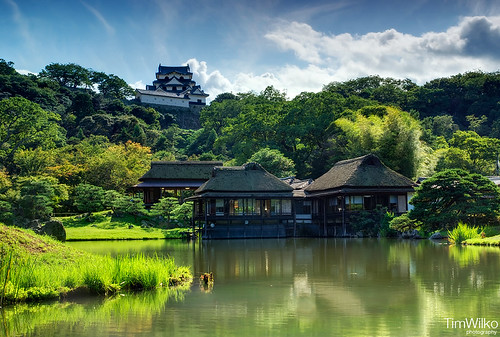
A view of Hikone castle from Genkyu-en garden in Hikone, Shiga prefecture, Japan.
Hikone castle is one of only four castles designated as national treasures. Built in 1622 by Naotaka Ii after the battle of Sekigahara in 1600.
Genkyu-en Garden was built in 1677 by Naooki Ii (Naotaka's younger brother). It was modeled after the villa of Emperor Genso, a ruler during China's Tang Period.
"A journey of a thousand miles must begin with a single step." -- Lao Tzu
Copyright © Demetrios the Traveler
travel
Saturday, February 7, 2009
Hokkaido Japan, ice show ...ενα φαντασμαγορικο θεαμα, απο παγο χιονι και φως στο Χοκαϊντο της Ιαπωνιας

lovely combination of snow, ice and light...
Ice pillars illuminated with colored lights are displayed during the Lake Shikotsu Ice Festival in Chitose, Hokkaido, Japan.
travel
Sunday, January 25, 2009
Kyoto Japan, Kinkaku-ji(a world heritage)

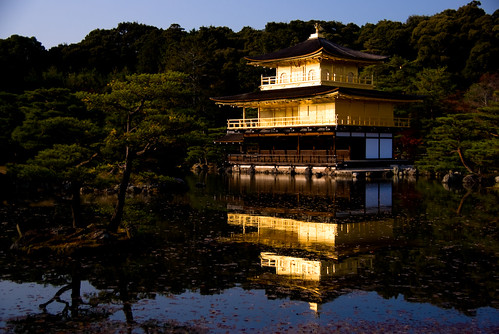
Kinkaku-ji (金閣寺, Kinkaku-ji?) or "Golden Pavilion Temple" is the informal name of Rokuon-ji (鹿苑寺, Rokuon-ji?) or "Deer Garden Temple" in Kyoto, Japan. It was originally built in 1397 to serve as a retirement villa for Shogun Ashikaga Yoshimitsu, as part of his estate then known as Kitayama.[1] It was his son who converted the building into a Zen temple of the Rinzai school. The temple was burned down twice during the Ōnin War.
The Golden Pavilion, or Kinkaku, is a three-story building on the grounds of the temple. The top two stories of the pavilion are covered with pure gold leaf. The pavilion functions as a shariden, housing relics of the Buddha (Buddha's Ashes). The building is often linked or contrasted with Ginkaku-ji, the Silver Pavilion Temple, which is also located in Kyoto.
The Golden Pavilion is set in a magnificent Japanese strolling garden (kaiyū-shiki). The pond in front of it is called Kyōko-chi (Mirror Pond). There are many islands and stones on the pond that represent the Buddhist creation story.
In 1950, the pavilion was burned down by a monk, who then attempted suicide on the Daimon-ji hill behind the building. He survived, but during the investigation after the monk's arrest, his mother was called in to talk with the police; on her way home, she committed suicide by jumping from her train into a river valley. The monk was sentenced to seven years in prison; he died of illness during his imprisonment in 1956. At that time, the statue of Ashikaga Yoshimitsu was burned. A fictionalized version of these events is at the center of Yukio Mishima's 1956 book The Temple of the Golden Pavilion.
"A journey of a thousand miles must begin with a single step." -- Lao Tzu
Copyright © Demetrios the Traveler
Sunday, June 22, 2008
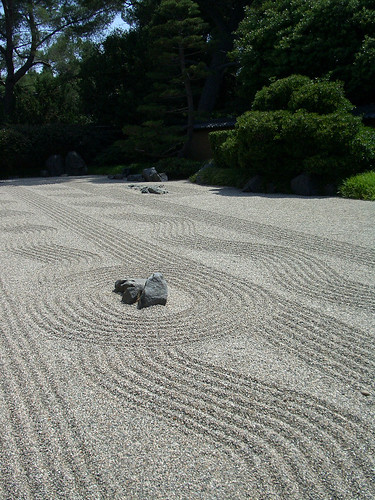
zen garden & haiku ....ένας κηπος Ζεν και ένα χαϊκού
Furuike ya
kawazu tobikomu
mizu no oto
Literal Translation
Fu-ru (old) i-ke (pond) ya,
ka-wa-zu (frog) to-bi-ko-mu (jumping into)
mi-zu (water) no o-to (sound)
Λιμνούλα παλιά
ο βάτραχος στον ήχο
πηδά του νερού.
An old pond!
A frog jumps in-
The sound of water.
松尾 芭蕉, Matsuo Basho(1644-1694)
Τα χαϊκού είναι είδος ποίησης που πρωτοεμφανίστηκε στην Ιαπωνία το δέκατο έκτο αιώνα και υιοθετήθηκε στην Ευρώπη στις αρχές του εικοστού.
Από εκεί πέρασαν τον Ατλαντικό και έφτασαν να γίνουν πολύ δημοφιλή σε όλο το Δυτικό κόσμο. Στην αυθεντική στιχουργική μορφή τους, τα χαϊκού είναι μικρά ποιήματα από 17 συλλαβές σε ένα ενιαίο στίχο.
Τα χαϊκού συμπυκνώνουν ευφυΐα και σοφία, που εκφράζονται με λυρική, ή άλλοτε, χιουμοριστική διάθεση, ενώ συχνά υπάρχει το στοιχείο της έκπληξης.
Στα χαϊκού σημαντική θέση έχουν η φύση, οι εποχές και τα χρώματα, η ομορφιά των λέξεων και των αντιθέσεων, ενώ το νόημα κάποιες φορές αποκτά δευτερεύουσα σημασία.
"Αρμονίη αφανής φανερής κρείττων" "η κρυμμένη αρμονία, είναι καλύτερη από τη φανερή"
Ηράκλειτος 5ος αιώνας π.Χ.
"A journey of a thousand miles must begin with a single step." -- Lao Tzu
Copyright © Demetrios the Traveler
Subscribe to:
Posts (Atom)
