Colmar is the third largest city in Alsace and a Jewelry box. You can see a lot of colorful very well-preserved half-timbered houses. Here "La petite Venise" with the Lauch river.
Colmar, die drittgrösste Stadt im Elsass, zeigt sich mit bunt bemalten, sehr gut erhaltenen Fachwerkhäusern von seiner besten Seite. Hier seht ihr das Schmuckkästchen, das Viertel Klein Venedig, am Fluss Lauch.
Colmar (French: Colmar, Alsatian: Colmer, German: Colmar, between 1940-1945 under Nazi rule: Kolmar) is a commune in the Haut-Rhin department in Alsace in north-eastern France. It is the capital of the department. Colmar is also the seat of the highest jurisdiction in Alsace, the appellate court. It is situated along the Alsatian Wine Route and considers itself to be the "Capital of Alsatian Wine" (capitale des vins d'Alsace). In 2006, the city of Colmar had a population of 65,713 and the metropolitan area of Colmar had a population of 120,367. Colmar is the center of the arrondissement of Colmar, which has 144,700 inhabitants in 2006.
Colmar is the home town of the painter and engraver Martin Schongauer and the sculptor Frédéric Bartholdi, who designed the Statue of Liberty. The city is renowned for its well preserved old town, its numerous architectural landmarks and its museums, among which the Unterlinden Museum.
Colmar was founded in the 9th century. This was the location where Charles the Fat held a diet in 884. Colmar was granted the status of a free imperial city of the Holy Roman Empire in 1226. During the Thirty Years' War, the city was taken by the armies of Sweden in 1632, who held it for two years. The city was conquered by France under Louis XIV in 1697.
In 1679 (Treaties of Nijmegen) Colmar was ceded to France. With the rest of Alsace, Colmar was annexed by the newly formed German Empire in 1871 as a result of the Franco-Prussian War. It returned to France after World War I, was annexed by Nazi Germany in 1940, and then reverted to French control after the battle of the "Colmar Pocket" in 1945.
The Colmar Treasure, hidden during the Black Death, was discovered here in 1863.
Colmar is 64 kilometres (40 mi) south-southwest of Strasbourg, on the Lauch River, directly to the east of the Vosges Mountains. It is connected to the Rhine by a canal.
Mostly spared by the destructions of the French Revolution and the wars of 1870-1871, 1914-1918 and 1939-1945, the cityscape of old-town Colmar is homogenous and renowned among tourists. The area crossed by canals of the river Lauch, and which formerly served as the butcher's, tanner's and fishmonger's quarter, is now called "little Venice" (la Petite Venise). Colmar's cityscape (and neighbouring Riquewihr's) served for the design of the Japanese animated film Howl's Moving Castle. (Source: Wikipedia)
Showing posts with label CULTURAL TOURS. Show all posts
Showing posts with label CULTURAL TOURS. Show all posts
Sunday, October 16, 2011


Wednesday, September 14, 2011
@ Cute Crete, Greece
A tilt-shift video by Joerg Daiber.
Locations: Agios Nikolaos, Spinalonga, Kritsa, Katharo, Pitsidia and Matala on Crete, Greece.
Shot with Lumix GH2, Gorillapod, 14-140mm and 7-14mm Lenses.
Post with Final Cut Pro and After Effects.
Music: Greece by Gayle Ellett.
The pretty side of the financial crisis.
Watch full screen!
Friday, February 18, 2011
the Moscow Kremlin, Russia

The Moscow Kremlin (Russian: Московский Кремль, Moskovskiy Kreml), sometimes referred to as simply The Kremlin, is a historic fortified complex at the heart of Moscow, overlooking the Moskva River (to the south), Saint Basil's Cathedral and Red Square (to the east) and the Alexander Garden (to the west). It is the best known of kremlins (Russian citadels) and includes four palaces, four cathedrals and the enclosing Kremlin Wall with Kremlin towers. The complex serves as the official residence of the President of Russia.
The name The Kremlin is often used as a metonym to refer to the government of the Soviet Union (1922–1991) and its highest members (such as general secretaries, premiers, presidents, ministers, and commissars), in the same way that the metonym Quai d'Orsay refers to the French Ministry of Foreign Affairs or White House refers to the Executive Office of the President of the United States. It is still used in reference to the government of the Russian Federation. "Kremlinology" referred to the study of Soviet and Russian policies.
Sunday, January 30, 2011
chinese and the people of China
EF - Live The Language - Beijing from Albin Holmqvist on Vimeo.
Commercial for EF Language Schools.
Directed by Gustav Johansson
D.O.P: Niklas Johansson
Typography: Albin Holmqvist
Produced at Camp David
"A journey of a thousand miles must begin with a single step." -- Lao Tzu Copyright © Demetrios the Traveler
France the people and their language
EF - Live The Language - Paris from Albin Holmqvist on Vimeo.
Commercial for EF Language Schools.
Directed by Gustav Johansson
D.O.P: Niklas Johansson
Typography: Albin Holmqvist
Produced at Camp David
"A journey of a thousand miles must begin with a single step." -- Lao Tzu Copyright © Demetrios the Traveler
Spain the language and the people
EF - Live The Language - Barcelona from Albin Holmqvist on Vimeo.
Commercial for EF Language Schools.
Directed by Gustav Johansson
D.O.P: Niklas Johansson
Typography: Albin Holmqvist
Produced at Camp David
"A journey of a thousand miles must begin with a single step." -- Lao Tzu Copyright © Demetrios the Traveler
Tuesday, November 9, 2010
Iran it's beautiful
Travel Inside Iran from Flo14wer on Vimeo.
For me Iran is a beautiful, magical country, a monument for the grandor of human civilization. Iran is a place where dazzling architecture is set amid desolate expanses of desert or steppe; where snow-capped mountains plunge dramatically to a seacoast of steamy lushness; where nomads guide their flocks to seasonal pasturelands; where tombs, temples, castles, and mosques bespeak the richness of the Persian past. High and dry for the most part, the land is sectioned by great mountain ranges, dotted with venerable villages of mud and stone as well as modern cities, and has a cultural fabric woven of many different threads, Persian,Turkish, Kurdish, Baluchi, ...
Sunday, June 6, 2010
Monastiraki sq., Athens Greece

Monastiraki (Greek: Μοναστηράκι, literally little monastery) is a flea market neighborhood in the old town of Athens, Greece, and is one of the principal shopping districts in Athens. The area is home to clothing boutiques, souvenir shops, and specialty stores, and is a major tourist attraction in Athens and Attica for bargain shopping. The area is named after Monastiraki Square, which in turn is named for the Pantánassa church monastery that is located within the square. The main streets of this area are Pandrossou Street and Adrianou Street.
"A journey of a thousand miles must begin with a single step." -- Lao Tzu Copyright © Demetrios the Traveler Sarawak Culture, Borneo, Malaysia
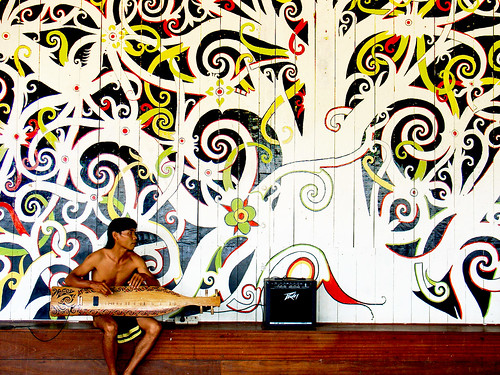
Sarawak is Malaysia's largest state. It lies in East Malaysia and shares the island of Borneo with the eastern state of Sabah, the separate country of Brunei and the Indonesian provinces of Kalimantan.
The Sarawak Cultural Village is sandwiched between Holiday Inn Damai Lagoon and Holiday Inn Damai Beach Resort. Walking from these two resorts is possible. From Kuching, the journey takes about 45 minutes through the spectacular peninsula of Santubong at which Damai seaside resorts are located. Taxi hire from downtown Kuching is possible but it can cost you a lot. Then there is a question of getting a taxi back to Kuching after you have finished visiting all the attractions the village. There will be an exorbitant surcharge should you require the taxi driver to wait for your return trip.
Saturday, June 5, 2010
The castle of Horst, Belgium.
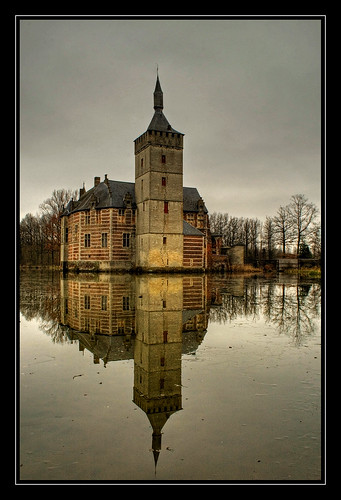
The home of the red knight!!
Horst Castle lies near the village of St. Pietersrode, north-east of the city of Brussels in Belgium.
When the first Horst Castle was built isn't known. And however there was a 'castellum Rode' in this area in the 11th century, the name Horst was first mentioned in 1263. Then a Jan van Thunen settled here and called himself Jan van Horst.
Horst Castle was built on a strategic spot in the Winge-valley and was one of the strenghts protecting the nearby city of Leuven which was the largest and most important city in the Duchy of Brabant during the 14th century.
In 1369 the castle was bought by an Amelric Boote who rebuilt it. Of his stronghold only the keep, part of the curtain wall and a part of the gate remains.
In 1488/89 the castle was burnt down by the people of Leuven during their war against Maximillian of Austria. Around 1490 the castle was rebuilt to its present appearance by a Lodewijk Pynnock. Before he could finish the castle he had to sell it in 1500, due to financial difficulties.
The new owner was Iwein van Kortenbach which caused the castle to come in the sphere of the town of Mechelen rather than Leuven.
In 1521 the castle was sold again, this time to the Van Buysleyden family. But this family also came into financial difficulties and had to sell the castle in the 17th century. This time it was sold to an Olivier van Schoonhoven who finally finished the rebuilding of the castle.
In 1630 Maria-Anna van den Tympel inherited the castle. She is the one who made the stucco ceilings in the three halls and was the last owner actually residing in the castle.
In the following centuries the ownership of the castle changed several times through inheritance. The new owners however weren't interested in the castle which had gotten out of fashion. The castle was mostly maintained by caretakers.
Nowadays the castle stands empty. During your visit you can walk through its halls and climb the keep all the way to the top through a narrow wall staircase. There is a little shop and a restaurant in the former coach-house on the bailey.
source: http://www.castles.nl/eur/be/hor/hor.html
Horst Castle lies near the village of St. Pietersrode, north-east of the city of Brussels in Belgium.
When the first Horst Castle was built isn't known. And however there was a 'castellum Rode' in this area in the 11th century, the name Horst was first mentioned in 1263. Then a Jan van Thunen settled here and called himself Jan van Horst.
Horst Castle was built on a strategic spot in the Winge-valley and was one of the strenghts protecting the nearby city of Leuven which was the largest and most important city in the Duchy of Brabant during the 14th century.
In 1369 the castle was bought by an Amelric Boote who rebuilt it. Of his stronghold only the keep, part of the curtain wall and a part of the gate remains.
In 1488/89 the castle was burnt down by the people of Leuven during their war against Maximillian of Austria. Around 1490 the castle was rebuilt to its present appearance by a Lodewijk Pynnock. Before he could finish the castle he had to sell it in 1500, due to financial difficulties.
The new owner was Iwein van Kortenbach which caused the castle to come in the sphere of the town of Mechelen rather than Leuven.
In 1521 the castle was sold again, this time to the Van Buysleyden family. But this family also came into financial difficulties and had to sell the castle in the 17th century. This time it was sold to an Olivier van Schoonhoven who finally finished the rebuilding of the castle.
In 1630 Maria-Anna van den Tympel inherited the castle. She is the one who made the stucco ceilings in the three halls and was the last owner actually residing in the castle.
In the following centuries the ownership of the castle changed several times through inheritance. The new owners however weren't interested in the castle which had gotten out of fashion. The castle was mostly maintained by caretakers.
Nowadays the castle stands empty. During your visit you can walk through its halls and climb the keep all the way to the top through a narrow wall staircase. There is a little shop and a restaurant in the former coach-house on the bailey.
source: http://www.castles.nl/eur/be/hor/hor.html
Sunday, May 23, 2010
Sunset in Bamberg, Bavaria, Germany
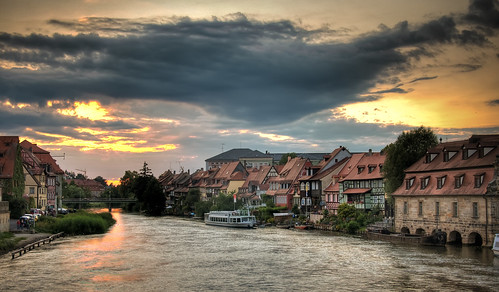
Bamberg is a town in Bavaria, Germany. It is located in Upper Franconia on the river Regnitz, close to its confluence with the river Main. Bamberg is one of the few cities in Germany that was not destroyed by World War II bombings because of a nearby Artillery Factory that prevented planes from getting near to Bamberg. Bamberg is home to nearly 7,000 foreign nationals, including over 4,100 members of the United States Army and their dependents. The name Bamberg is supposed to have its origin in the House of Babenberg.
source: http://en.wikipedia.org/wiki/Bamberg
"A journey of a thousand miles must begin with a single step." -- Lao Tzu Copyright © Demetrios the Traveler
Dunluce Castle, Antrim Coast, Northern Ireland.
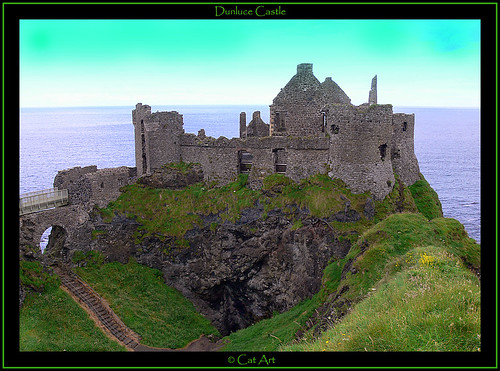
The limestone cliffs of the White Rocks ends abruptly against a dark basalt outcrop which is majestically crowned by Dunluce Castle and joined to the mainland by an arched walkway, underneath lies the ' Mermaid's Cave'. It is believed that the castle was built or (possibly) rebuilt by Richard de Burgh or one of his chief followers during the Anglo Norman period in Ireland. The site certainly was occupied as a fort before this time, a souterrain exists on the outcrop under one of the towers. The castle which has seen many additions to its original structure over the centuries gradually fell into disuse from the late 1600s' when the last occupier, Randall MacDonnell, the second Earl of Antrim moved to Ballymagarry House. In the mid 1700s the seat of the Earl's of Antrim moved to the present location of Glenarn Castle. A thriving merchant village that once surrounded the castle was destroyed by fire during 1641 when the castle was besieged by an Irish army, the outlines of some of the old walls can still be seen in the land to the west of the castle. Close by is the ancient church ruins of St. Cuthbert's named after a Northumbrian monk and the (possible) burial site of sailors and noblemen from the Spanish Armada. The most colourful occupier of Dunluce Castle was Sorley Boy MacDonnell, a Scottish chieftain whose clan established their dominance along the north coast in the mid 1500s, he had many differences of opinion with Queen Elizabeth who sent Sir John Perrottt here in 1584 to bring him to task but Sorley evaded arrest. Dunluce Castle was fought over many times in its past and it is wrapped in myths and legends. On a clear day you can look over an expanse of ocean from here to Donegal and round to Islay, a view which has remained unchanged for centuries.
Hundertwasser House, Vienna, Austria
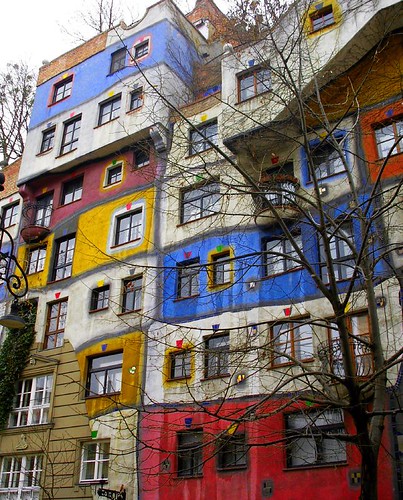
The Hundertwasser House is an apartment house in Vienna, Austria, designed by Austrian artist Friedensreich Hundertwasser. This landmark of Vienna is located in the 3. district, Kegelgasse 34-38 / Löwengasse 41-43.
The house was built between 1983 and 1986. It features undulating floors, a roof covered with earth and grass, and large trees growing from inside the rooms, with limbs extending from windows. Hundertwasser took no payment for the design of the house, declaring that it was worth it, to prevent something ugly from going up in its place.
Within the house there are 52 apartments, four offices, 16 private terraces and three communal terraces, and a total of 250 trees and bushes. The Hundertwasser House is one of Austria's most visited buildings and has become part of Austria's cultural heritage.
(Adapted from: Wikipedia)
"A journey of a thousand miles must begin with a single step." -- Lao Tzu Copyright © Demetrios the Traveler
Casa Batlló, Barcelona, Spain
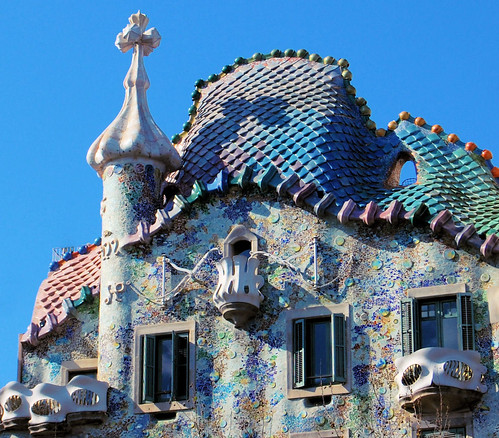
Between 1898 and 1906 three adjacent houses in one block on the fashionable boulevard 'Passeig de Gracia' were built by some of the most important modernist architects: Casa Amatller (designed by Puig i Cadafalch), Casa Lléo Morera (designed by Domènech i Montaner) and Gaudí's Casa Batlló.
All three houses were designed in a different interpretation of the modernist style in what seems like a competition between the architects. This lead to the local term 'Mançana de la Discordia', which means apple of discord, referring to Greek mythology where an apple, given by the goddess Eris 'to the fairest' lead to a dispute between three goddesses, eventually leading to the Trojan War. Conveniently the word mançana also means 'block', so the expression 'Mançana de la Discordia' can also be translated as 'Block of Discord'.
Of the three houses, Wooden door, Gaudi style Casa Batlló is the most expressive. The house was originally built between 1875 and 1877. In 1900 it was bought by the rich industrialist Josep Battló i Casanovas who commissioned Gaudí to tear down the old house and reconstruct a new one. Gaudí however convinced Battló to remodel the existing building. Between 1904 and 1906 Gaudí redesigned the facade and roof, added an extra floor and completely remodeled the interior.
The façade of the Casa Batlló is quite whimsical. It is made of sandstone covered with colorful trencadis (a Catalan type of mosaic). Typical of Gaudí, straight lines are avoided whenever possible. The first floor features irregularly sculpted oval Detail of the roofwindows. Balconies at the lower floors have bone-like pillars, those on the upper floors look like pieces of skulls. These features gave the house the nickname 'House of Bones'. The enlarged windows on the first floor gave it another nickname, 'House of Yawns'.
The colorful scaled roof recalls a reptile skin. According to some authorities on Gaudí architecture, the roof represents a dragon; the small turret with a cross would symbolize the sword of St. George stuck into the dragon. The bones and skulls on the facade represent all the dragon's victims.
"A journey of a thousand miles must begin with a single step." -- Lao Tzu Copyright © Demetrios the Traveler
Saturday, April 17, 2010
Mont St. Michel, France
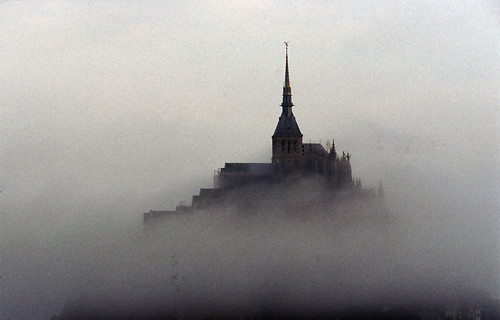
Mont-Saint-Michel is a 1-ha (3-acre) rocky islet topped by a famous Gothic abbey, 1.6 km (1 mi) off the coast of Normandy in northwest France in the Bay of Mont-Saint-Michel in the English Channel. The island, located 5 km (3 mi) from the shore during the Middle Ages, is now surrounded by water only two times a month. Its one cobblestone street climbs in three spirals from a great granite base to the towering Benedictine abbey of Mont-Saint-Michel, an architectural masterpiece built in the 13th century, replacing the original abbey, which was founded in 708 by Saint Aubert, bishop of Avranches, but destroyed by King Philip II of France in 1203.
Its fortifications enabled the islet to withstand repeated English assaults during the Hundred Years' War. The abbey served as a prison during Napoleon I's reign. Restored after 1863, and connected to the mainland by a causeway (completed 1875), the abbey is preserved as a national historical monument and a UNESCO World Heritage Site. It is one of France's great tourist attractions. The abbey is celebrated in Henry Adam's classic study of medieval Christianity, Mont Saint Michel and Chartres (1913).
On the other side of the English Channel, off the coast of Cornwall, in England, is Saint Michael's Mount, the site of a priory (later a castle) that belonged to the Mont-Saint-Michel abbey in the Middle Ages.
Its fortifications enabled the islet to withstand repeated English assaults during the Hundred Years' War. The abbey served as a prison during Napoleon I's reign. Restored after 1863, and connected to the mainland by a causeway (completed 1875), the abbey is preserved as a national historical monument and a UNESCO World Heritage Site. It is one of France's great tourist attractions. The abbey is celebrated in Henry Adam's classic study of medieval Christianity, Mont Saint Michel and Chartres (1913).
On the other side of the English Channel, off the coast of Cornwall, in England, is Saint Michael's Mount, the site of a priory (later a castle) that belonged to the Mont-Saint-Michel abbey in the Middle Ages.
"A journey of a thousand miles must begin with a single step." -- Lao Tzu
Copyright © Demetrios the Traveler
Fairytale Castle - Burg Eltz, Germany
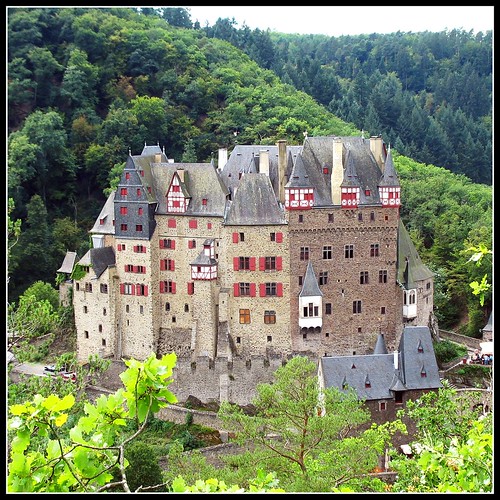
Burg Eltz is a medieval castle nestled in the hills above the Moselle River between Koblenz and Trier, Germany. It is still owned by a branch of the same family that lived there in the 12th century, 33 generations ago. The Rübenach and Rodendorf families' homes in the castle are open to the public during the summer month, while the Kempenich branch of the family uses the other third of the castle.
The castle is surrounded on three sides by the Elzbach River, a tributary on the north side of the Moselle. It is situated on a 70m rock spur, on an important Roman trade route between the rich farm lands and their markets.
The main part of the house consists of the family portions. At up to eight storeys, these eight towers reach heights of between 30 and 40 meters. They are fortified with strong exterior walls; to the yard they present a partial framework. About 100 members of the owners' families lived in the over 100 rooms of the castle. (Source: en.wikipedia.org/wiki/Burg_Eltz)
After all Burg Eltz beautified for many years the back of the 500 DM banknote (German currency).
"A journey of a thousand miles must begin with a single step." -- Lao Tzu
Copyright © Demetrios the Traveler
Saturday, April 10, 2010
Sarlat, Dordogne, France
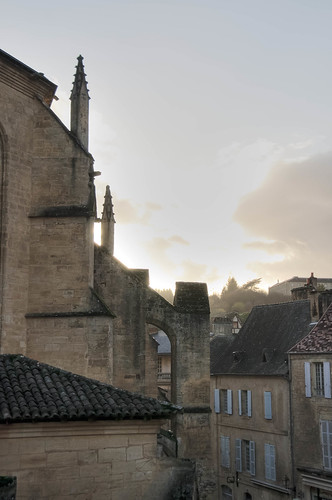
Sarlat - Now we're talking! The most famous town in the region and one of the most renowned and visited in France. It is also one of the most attractive. Often called just Sarlat, the town is actually twinned with its less famous neighbour and is more correctly called Sarlat le Caneda.
Destined to be besieged by tourists at almost all times of the year Sarlat is a beautiful, well restored town a few kilometres north of the River Dordogne. The old town, dating from both medieval and renaissance times is a pleasure to visit, especially during the spring and autumn, or early in the morning. If you can catch the early morning sunshine on the yellow sandstone buildings, so much the better.
Don't miss the streets around the cathedral and the streets to the north of the old town when you visit Sarlat. You will soon become lost in the maze of narrow lanes, with something new to see around every corner. No major sights perhaps - the cathedral in Sarlat is not very exciting, for example - but as a whole town is very attractive.
Before setting off for your walk around Sarlat, visit the tourist office which can provide a suggested walking tour to take in the key attractions. Broadly, the pedestrianised Rue de la Republique runs the length of the old town, with mazes of narrow streets either side. The cathedral is to the south-east of Sarlat, with the attractive Cour des Fontaines and Cour des Chanoines behind.
Frequently you will think yourself lost in the winding medieval streets - don't worry, it's essentially a small town, and sooner or later you will emerge into the light and refind your path!
Don't forget to glance up from time to time as you explore the medieval cobbled streets - the rooves of the buildings in medieval Sarlat are often in 'lauze' - carefully cut stone - and are unusual elsewhere.
Market day in Sarlat is a Saturday.
Destined to be besieged by tourists at almost all times of the year Sarlat is a beautiful, well restored town a few kilometres north of the River Dordogne. The old town, dating from both medieval and renaissance times is a pleasure to visit, especially during the spring and autumn, or early in the morning. If you can catch the early morning sunshine on the yellow sandstone buildings, so much the better.
Don't miss the streets around the cathedral and the streets to the north of the old town when you visit Sarlat. You will soon become lost in the maze of narrow lanes, with something new to see around every corner. No major sights perhaps - the cathedral in Sarlat is not very exciting, for example - but as a whole town is very attractive.
Before setting off for your walk around Sarlat, visit the tourist office which can provide a suggested walking tour to take in the key attractions. Broadly, the pedestrianised Rue de la Republique runs the length of the old town, with mazes of narrow streets either side. The cathedral is to the south-east of Sarlat, with the attractive Cour des Fontaines and Cour des Chanoines behind.
Frequently you will think yourself lost in the winding medieval streets - don't worry, it's essentially a small town, and sooner or later you will emerge into the light and refind your path!
Don't forget to glance up from time to time as you explore the medieval cobbled streets - the rooves of the buildings in medieval Sarlat are often in 'lauze' - carefully cut stone - and are unusual elsewhere.
Market day in Sarlat is a Saturday.
"A journey of a thousand miles must begin with a single step." -- Lao Tzu
Copyright © Demetrios the Traveler
Tuesday, March 30, 2010
Oman - Mausolée de Bin Ali
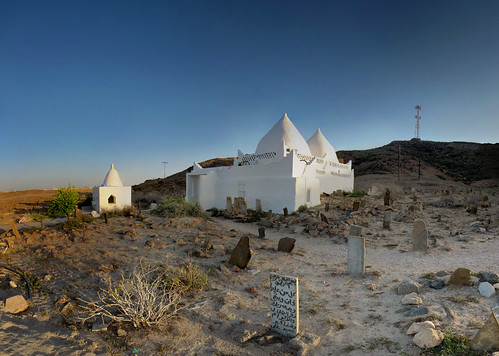
Oman’s unique story reveals examples of great moral strength, courage, heroism, maritime skills, scholarship and hard work that have together moulded the Sultanate into its present form. By drawing our attention to the noble efforts of distinguished Omanis, historians have provided us with a deeper understanding of the great wealth of human experience that is at the foundation of modern Oman.
An understanding of Oman’s place at the heart of the Middle East and its relationship with neighbouring countries is central to understanding the international position of Oman today as well as its internal dynamics.
Oman occupies the far south-eastern corner of the Arabian Peninsula, its geographical boundaries clearly defined by nature from earliest times.
The earliest Stone Age settlement discovered in Oman is in the Wattaya district and dates back more than 10,000 years.
Babylon and Assyria were among the first empires to control the Asian land trade from the Arabian Gulf to the eastern shores of the Mediterranean. Later the Persian Empire expanded to gain influence over a vast area and control the region’s trade.
The rule of the Imams in Oman began in the eighth century C.E. Ibn Masoud was elected as the first imam in 751 and his reign lasted for four centuries until 1154. The Oman of the Imams was in the Nabhan period between the thirteenth and fifteenth centuries AD; attempts to revive the Imamate in Oman were renewed in the fifteenth century but these attempts failed.
Between 1498 to 1507, after Portugal had occupied the trading ports of East Africa along with Aden, the Portuguese stranglehold, which lasted for more than a century and a half, was to fail because of Oman’s spirited resistance and the election of Imam Nasir bin Murshid to the Imamate in 1624 AD.
The Portuguese possessions in India suffered tremendously from the Omani strikes. Portuguese and Omanis engaged in bloody battles for the control of East Africa, until the entire East African shore from Mombassa to Kilwa fell under Omani control. In 1698 AD the Omanis conquered Mombassa and then entered Pemba, Zanzibar and Patta, Mozambique was the only country that resisted the Omani Arab fleet, and it stayed under Portuguese control until the twentieth century.
Despite repeated attempts from 1737-1744 AD, the Persian invasions were not to achieve their objective of subduing Oman because of the valiant resistance put up by the Omanis. Oman’s heroic resistance staved off the Persian invasion in that period and their ultimate victory is owing to the leadership of Ahmed bin Said Al-Busaidi who succeeded in ousting the Persians from Oman and was elected Imam in 1744 AD,
In 1970 His Majesty Sultan Qaboos bin Said, the Crowning Glory of Oman, inaugurated the renaissance and modern age of Oman
Copyright © Demetrios the Traveler
Sunday, March 28, 2010
Το κάστρο της Λάρισσας... στο Αργος
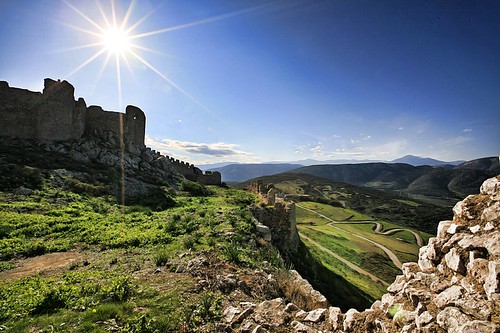
Το κάστρο έχει υψόμετρο 289 μ. Οικοδομήθηκε κατά τους προϊστορικούς χρόνους και είναι νεότερο από τις οχυρώσεις της Ασπίδος. Η βάση του σε ορισμένα σημεία έχει ογκόλιθους, που μας θυμίζουν τα κυκλώπεια τείχη. Τον 5ο και 6ο αι. οι Αργείοι επισκευάζουν και συμπληρώνουν το τείχος, ακολουθώντας τα παλαιότερα ίχνη. Σημαντικά τμήματα της εποχής εκείνης σώζονται στο βόρειο και δυτικό τμήμα.
Τον 10ο αι. μ.Χ. κτίστηκε το μεσαιωνικό κάστρο. Τον 13ο αι. το ανανέωσαν οι Φράγκοι, τον 15ο αι. το συμπλήρωσαν οι Ενετοί και αργότερα οι Τούρκοι έκαναν τις δικές τους προσθήκες. Όλοι όσοι το διαφέντεψαν, Έλληνες και μη, φρόντισαν ν’ αφήσουν τα ίχνη της οχυρωματικής τους τέχνης στο επιβλητικό μνημείο, που δεσπόζει στην πεδιάδα του Άργους.
Κηρύχθηκε διατηρητέο μνημείο το 1992 (ΦΕΚ 28 Α/1922).
"A journey of a thousand miles must begin with a single step." -- Lao Tzu Τον 10ο αι. μ.Χ. κτίστηκε το μεσαιωνικό κάστρο. Τον 13ο αι. το ανανέωσαν οι Φράγκοι, τον 15ο αι. το συμπλήρωσαν οι Ενετοί και αργότερα οι Τούρκοι έκαναν τις δικές τους προσθήκες. Όλοι όσοι το διαφέντεψαν, Έλληνες και μη, φρόντισαν ν’ αφήσουν τα ίχνη της οχυρωματικής τους τέχνης στο επιβλητικό μνημείο, που δεσπόζει στην πεδιάδα του Άργους.
Κηρύχθηκε διατηρητέο μνημείο το 1992 (ΦΕΚ 28 Α/1922).
Copyright © Demetrios the Traveler
Umayyad Mosque, After © WWF Syria.
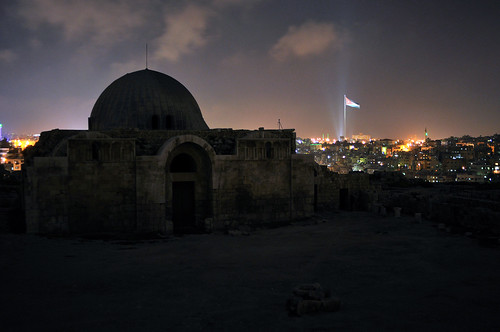
The Ummayad Mosque, also known as the Grand Mosque of Damascus (Arabic: جامع بني أمية الكبير, transl. Ğām' Banī 'Umayyah al-Kabīr), is one of the largest and oldest mosques in the world. Located in one of the holiest sites in the old city of Damascus, it is of great architectural importance.
After the Arab conquest of Damascus, the mosque was built on the Christian basilica dedicated to John the Baptist since the time of the Roman emperor Constantine I. The mosque holds a shrine which still today contains the head of John the Baptist (Yahya), honored as a prophet by both Christians and Muslims alike. There are also many important landmarks within the mosque for the Shī‘ah, among them is the place where the head of Husayn (the grandson of Muhammad) was kept on display by Yazīd I. There is also the tomb of Saladin, which stands in a small garden adjoining the north wall of the mosque.
In 2001 Pope John Paul II visited the mosque, primarily to visit the relics of John the Baptist. It was the first time a pope paid a visit to a mosque.
"A journey of a thousand miles must begin with a single step." -- Lao Tzu
Copyright © Demetrios the Traveler
Subscribe to:
Posts (Atom)
