Showing posts with label ATHENS. Show all posts

Thursday, September 15, 2011

Greece's Top 10 Archaeological Sites

A visit to Greece allows the opportunity to go back through the corridors of time with some of the most awesome archaeological sites in the world. Greece is literally a network of the remains of civilizations that date from as far back as the prehistoric times and weaves its way through early historic, Roman and Byzantine periods. Here are 10 of the best of the archaeological sites in Greece:

1. Acropolis of Athens


The Parthenon - Photo: B. Paige

Sitting on the highest point and overlooking the city is the “Citadel of Athens.” One of the most significant monuments and testament to the great architectural heritage of Greece, the Acropolis was a brainchild of the statesman Pericles and built during the 5th century. This ancient religious site bears the remains of a number of temples and statues including the Propylea Gateway, the Parthenon, the Erechtheum and the Theatre of Dionysus. Most of the artifacts found during the excavations are now displayed in the Acropolis Museum.

2. Delphi


The Temple of Apollo - Photo: A. Pappa

Delphi is most famous for the legendary and influential oracle found in numerous ancient Greek writings and is situated in central Greece on the slope of Mount Parnassus. Legend has it that the Greek god Apollo used the oracle to speak to humans through a medium called the Pythia, or a priestess of the Delphi.  Discovered in 1893, the site today is one of the most popular tourist attractions in Greece with its spectacular remains of the Temple of Apollo, the Stadium, Athenian Treasury and the Altar of the Chians among others.

3. Sacred Island of Delos


Naxian Lions Terrace of Delos - Photo: A. Pippo

Also known as the Island of Apollo, this small but historically significant sanctuary is located in the heart of Cyclades just miles away from Mykonos. During the ancient times, it was the center of religion, trade, commerce and politics and its discovery in 1873 was monumental in that it bore testament to a highly advanced civilization.  Must-sees include the Agora, the Temple of the Lions, the Sanctuary and the Theatre District.

4. Olympia


Ruins of the Philippeion - Photo: M. Fitzpatrick

The site of the first Olympic games and an ancient sanctuary, the site was first discovered and excavated in 1829. Ancient Olympia was situated in Peloponesse and has been declared a UNESCO World Heritage Site in 1989. Today, the town is a flourishing community of municipalities and subdivisions. Visitors to the ancient ruins can still see impressive monuments such as the Stadium, the temples dedicated to Zeus and Hera and the Palaestra.

5. Knossos


Knossos Minoan Palace - Photo: S. Leon

Another legendary site is Knossos, the largest and best preserved archaeological find from the Bronze Age and the remains of the great Minoan civilization. The grand Palace of Knossos was home to King Minos and the setting for many heroic tales and epics including the Minotaur in the Labyrinth and Icarus. Aside from the palace visitors can see the Royal Villa, the intricate frescoes on the walls and the Minoan Columns.

6. Vergina


A tomb in Vergina - Photo: B. Dirah

Also known as the Archaeological Site of Agai (or Aegae), this ancient Macedonian capital was brought to global attention in 1977 with the discovery of the burial site of the kings of Macedon including Philip II and Alexander IV. Valuable artifacts found in the site are now housed in the Great Tumulus Museum.

7. Sanctuary of Asklepios at Epidaurus


Theatre of Epidaurus - Photo: H. Melo

According to legend, Asklepios was a god of medicine and was worshipped in the city state of Epidaurus in Ancient Greece. A huge sanctuary was built in his honor (the “Asclepieion) and became the center of activity in Epidaurus with throngs of people coming to find healing for their conditions. Other majestic ancient monuments uncovered in the site include the theatre, palace and tombs.

8. Lindos


Acropolis of Lindos - Photo: A. Anna

Situated in the island of Rhodes is the citadel of Lindos, an ancient fortified area that has been in existence since the 10th century BC. It was an important trading post in the 7th to 6th centuries BC but declined in significance after the rise of Rhodes in the 5th century. The most important find is the Doric Temple of Athena along with the Propylaea and the Hellenistic wall.

9. Meteora


The Monastery of the Holy Trinity - Photo: D. Jarmin

From the Greek word which means “suspended in the air” the Meteora Monasteries have come to be known as one of Greece’s most impressive sites. It is a community of  six Greek Orthodox monasteries started and built during the 9th century on rock pillars and along high mountain walls at the edge of Thessaly and along the Eastern Pindus Mountains. In the old times, the only way to get to the monasteries was by hoisting up long ladders or large nets. Today, visitors can reach the place through staircases that were made from the rock formations.

10. Mycenae


The Lion Gate - Photo: E. Rones

The once mighty and glorious civilization of Mycenae is situated on a hill in Northeastern Peloponnese in Argolis. From the 5th to the 1st century BC, Mycenae was the political, cultural, religious and military center so much so that the period has come to be known in Greek history as Mycenaean. Vestiges if its grandeur can still be seen in the citadel ruins – the Lion Gates, Treasury of Atreus and Grave Circle A are among the impressive architecture that can be seen in the site.


Tuesday, September 13, 2011

Monastiraki Square, Athens, Greece


Monastiraki Square, originally uploaded by Visit Greece.
Athens is the historical capital of Europe, with a long history, dating from the first settlement in the Neolithic age. In the 5th Century BC (the “Golden Age of Pericles”) – the culmination of Athens’ long, fascinating history – the city’s values and civilization acquired a universal significance. Over the years, a multitude of conquerors occupied Athens, and erected unique, splendid monuments - a rare historical palimpsest. In 1834, it became the capital of the modern Greek state and in two centuries since it has become an attractive modern metropolis with unrivalled charm.

Via Flickr:
Athens is the historical capital of Europe, with a long history, dating from the first settlement in the Neolithic age. In the 5th Century BC (the “Golden Age of Pericles”) – the culmination of Athens’ long, fascinating history – the city’s values and civilization acquired a universal significance. Over the years, a multitude of conquerors occupied Athens, and erected unique, splendid monuments - a rare historical palimpsest. In 1834, it became the capital of the modern Greek state and in two centuries since it has become an attractive modern metropolis with unrivalled charm.

Photo: (GNTO / Yannis Skoulas)
--
www.visitgreece.gr

Sunday, February 27, 2011

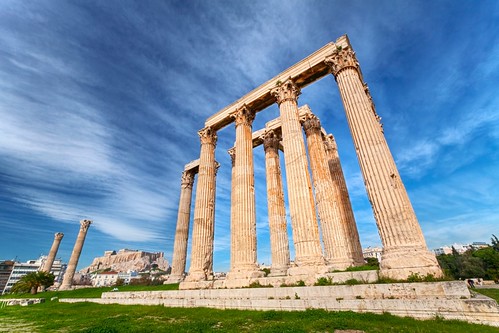
Temple of Olympian Zeus, Athens, Greece


Temple of Olympian Zeus, originally uploaded by Vasilis Tsikkinis.

The Temple of Olympian Zeus (Greek: Ναὸς τοῦ Ὀλυμπίου Διός, Naos tou Olympiou Dios), also known as the Olympieion or Columns of the Olympian Zeus, is a colossal ruined temple in the centre of the Greek capital Athens that was dedicated to Zeus, king of the Olympian gods. Construction began in the 6th century BC during the rule of the Athenian tyrants, who envisaged building the greatest temple in the ancient world, but it was not completed until the reign of the Roman Emperor Hadrian in the 2nd century AD some 638 years after the project had begun. During the Roman periods it was renowned as the largest temple in Greece and housed one of the largest cult statues in the ancient world.
The temple's glory was short-lived, as it fell into disuse after being pillaged in a barbarian invasion in the 3rd century AD. It was probably never repaired and was reduced to ruins thereafter. In the centuries after the fall of the Roman Empire, the temple was extensively quarried for building materials to supply building projects elsewhere in the city. Despite this, substantial remains remain visible today and it continues to be a major tourist attraction.

Monday, June 14, 2010

5 "HOT Summer" Deals

Go island hopping in Greece, stay at a beachfront hotel in Bali, plus three more discounted getaways around the world.
All prices are per person and, if lodging is a component of the package, based upon two people traveling together (unless otherwise noted). The prices listed are general starting rates; see "What Else You'll Have to Pay" for details about associated taxes and fees. Base-prices, taxes, and fees can vary based on point of departure and time of travel. Trip add-ons like sightseeing tours and meal plans may also increase the price. Check with the tour operator for additional gateways and any single supplements, which is the extra cost that a solo traveler would pay to book the deal.


Photo Caption: The waterfront in Mykonos, Greece.
Photo by Helen Weismeyer/Frommers.com Community


Read more: Frommer's 5 Deals for June 9, 2010 Slideshow at Frommer's

"A journey of a thousand miles must begin with a single step." -- Lao Tzu Copyright © Demetrios the Traveler

Sunday, June 6, 2010

Monastiraki sq., Athens Greece


perfusion, originally uploaded by argyrio d'emmanuelli.

Monastiraki (Greek: Μοναστηράκι, literally little monastery) is a flea market neighborhood in the old town of Athens, Greece, and is one of the principal shopping districts in Athens. The area is home to clothing boutiques, souvenir shops, and specialty stores, and is a major tourist attraction in Athens and Attica for bargain shopping. The area is named after Monastiraki Square, which in turn is named for the Pantánassa church monastery that is located within the square. The main streets of this area are Pandrossou Street and Adrianou Street.
"A journey of a thousand miles must begin with a single step." -- Lao Tzu Copyright © Demetrios the Traveler

Thursday, May 13, 2010

Kalimera visit Greece!


"A journey of a thousand miles must begin with a single step." -- Lao Tzu Copyright © Demetrios the Traveler

Tuesday, May 4, 2010

this is not my country...

my country is full of sun, blue sea,smile ..even under austerity

Protesters take over Acropolis


"A journey of a thousand miles must begin with a single step." -- Lao Tzu Copyright © Demetrios the Traveler

Friday, January 1, 2010

The temple of Zeus (Αθήνα / Athens) Greece


"A journey of a thousand miles must begin with a single step." -- Lao Tzu
Copyright © Demetrios the Traveler


Digg!


Monday, December 21, 2009

Erechtheum (Greek: Ἐρέχθειον Erechtheion), Acropolis, Athenσ, Greece.


athen_jungfrau_840, originally uploaded by ladypabbit.

The Erechtheum (Greek: Ἐρέχθειον Erechtheion) is an ancient Greek temple on the north side of the Acropolis of Athens in Greece.

The Erectheum was associated with some of the most ancient and holy relics of the Athenians: the Palladion, which was a xoanon (defined as a wooden effigy fallen from heaven - not man-made) of Athena Polias (Protectress of the City); the marks of Poseidon's trident and the salt water well (the "salt sea") that resulted from Poseidon's strike; the sacred olive tree that sprouted when Athena struck the rock with her spear in her successful rivalry with Poseidon for the city; the supposed burial places of the mythical kings Cecrops and Erechtheus; the sacred precincts of Cecrops' three daughters, Herse, Pandrosus and Aglaurus; and those of the tribal heroes Pandion and Boutes.

The temple itself was dedicated to Athena Polias and Poseidon Erechtheus. Within the foundations lived the sacred snake of the temple, which represented the spirit of Cecrops and whose well-being was thought essential for the safety of the city.

The snake was fed honey-cakes by Canephorae, the priestesses of Athena Polias, by custom the women of the ancient family of Eteoboutadae, the supposed descendants of the hero Boutes. The snake's occasional refusal to eat the cakes was thought a disastrous omen.


"A journey of a thousand miles must begin with a single step." -- Lao Tzu
Copyright © Demetrios the Traveler


Digg!


Saturday, October 10, 2009

Former Glory,Zeus temple, Athens Greece


Former Glory, originally uploaded by _skynet.

The Temple of Olympian Zeus (Greek: Ναός του Ολυμπίου Διός or Naos tou Olimpiou Dios), also known as the Olympieion, is a colossal ruined temple in the centre of the Greek capital Athens that was dedicated to Zeus, king of the Olympian gods. Construction began in the 6th century BC during the rule of the Athenian tyrants, who envisaged building the greatest temple in the ancient world, but it was not completed until the reign of the Roman Emperor Hadrian in the 2nd century AD some 650 years after the project had begun. During theRoman periods it was renowned as the largest temple in Greece and housed one of the largest cult statues in the ancient world.

The temple's glory was shortlived, as it fell into disuse after being pillaged in a barbarian invasion in the 3rd century AD. It was probably never repaired and was reduced to ruins thereafter. In the centuries after the fall of the Roman Empire, the temple was extensively quarried for building materials to supply building projects elsewhere in the city. Despite this, substantial remains remain visible today and it continues to be a major tourist attraction.


"A journey of a thousand miles must begin with a single step." -- Lao Tzu
Copyright © Demetrios the Traveler


Digg!


Monday, August 24, 2009

Athens, Greece wildfires


"A journey of a thousand miles must begin with a single step." -- Lao Tzu
Copyright © Demetrios the Traveler


Digg!


Sunday, July 12, 2009

Temple of Hephaestus and Athena Ergane, Athens Greece


Theseion, originally uploaded by maksid.

On top of Agoraios Kolonos hill, which is delimiting the Ancient Agora of Athens to the west, stands the temple of Hephaestus, broadly known as ?Thisio?. It is one of the best preserved ancient temples, partly because it was transformed into a Christian church. According to the traveller and geographer Pausanias (1, 14, 5-6), two deities were jointly worshipped in the temple: god Hephaestus, protector of all metallurgists, and goddess Athena Ergani, protecting all potters and the cottage industries. The identification of this temple as ?Hephaesteion? (location of worship of the god Hephaestus) was ascertained by the excavations and investigations that brought to light metallurgy workshops on the wider area of the hill, thus outshining earlier opinions presuming that Theseus, Hercules or Aris (Mars) were the deities worshipped there. The temple was probably erected between 460 and 420 BC by a yet unknown architect, to whom, however, are attributed other temples of similar structure in the Attica region.

The temple disposed of a pronaos (anteroom) and an opisthodomos (back section), both distyle (two-columned) in antis. On the exterior it was surrounded by a Doric colonnade having six columns on the narrow sides and thirteen columns on the longer sides. The entire building, from the crepis (stone base) to the roof, was made of marble produced in the quarries of Pendeli mountain (in Attica), while the architectural sculptures that adorned the temple were of marble produced in the quarries on the island of Paros. On the interior of the cella (in Greek sekos) was a two-part colonnade forming the letter Π and at the far end was a pedestal, that supported the bronze ceremonial statues of Hephaestus and Athena, created by the sculptor Alkamenis; according to the traveller and geographer Pausanias, they were probably executed between 421 and 415 BC. The lavish sculptural decoration of the temple featured highly interesting metopes that adorned the east and the west side of the external colonnade. The east side numbered ten metopes that were visible from the Agora: they depicted nine of the feats of Hercules. Furthermore, on the north and the south side are depicted four of the feats of Theseus, which probably were the reason why the people named this temple "Thision". The frieze does not run across all four sides of the cella, but only the across the pronaos and the opisthodomos. The pronaos features the victorious struggle of Theseus against the claimers of the throne, who were the fifty sons of Pallas; six gods also participate into the fight. The opisthodomos depicts the fight of the Centaurs narrated on the wall which is against the cella. Notable sculptural representations also adorned the pediments of the temple. The west pediment depicted the fight of the Centaurs and the east pediment the reception of Hercules on mount Olympus or the birth of goddess Athena. Several among these sculptures inspired statues that were found in the surroundings of the temple, such as the fragmented and partially preserved complex of two feminine figures, one of which transports the other on her shoulders, as if trying to save her life, ("Ephedrismos" = carrying on one's back), Museum of the Ancient Agora, no of finding S 429), or the trunk of a dressed feminine figure where the movement is intensely underlined; the latter could be one of the acroteria (ornamental corner pieces) of the temple ("Nereis" = water deity, Museum of the Ancient Agora, no of finding S 182).

During the Hellenistic period, bushes or small trees in parallel order were planted into flowerpots around the temple; these pots came to light during excavation. In the seventh century AD, the temple was conversed into a church dedicated to St. George Akamas, and thus stayed in use until the liberation of Greece from the Turkish occupation. During the eighteenth century, many eminent Protestants, who died in Athens, were interred in the edifice, while in 1834 it hosted the ceremony of the first reception of king Otto. Hence the temple was used as an archaeological museum, until 1930, when the American School for Classical Studies in Athens started excavations in the Ancient Agora.
Author
Klio Tsoga, archaeologist

Thursday, July 9, 2009

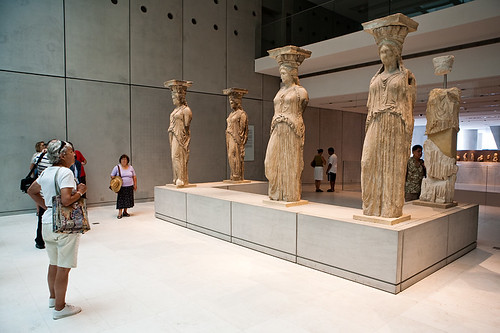
Caryatids of the Erechtheion


Caryatids of the Erechtheion, originally uploaded by macropoulos.
The famous Caryatids, originally from the north porch of the Erechtheion temple (on the Acropolis), as they are now being displayed in the new Acropolis Museum.
caryatid (Greek: Καρυάτις, plural: Καρυάτιδες) is a sculpted female figure serving as an architectural support taking the place of a column or a pillar supporting an entablature on her head. The Greek term karyatides literally means "maidens of Karyai", an ancient town of Peloponnese. Karyai had a famous temple dedicated to the goddess Artemis in her aspect of Artemis Karyatis. en.wikipedia.org/wiki/Caryatid 
"A journey of a thousand miles must begin with a single step." -- Lao Tzu
Copyright © Demetrios the Traveler

Saturday, June 20, 2009

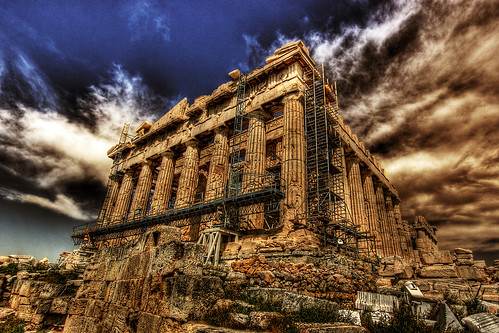
Restoration of the Parthenon


The Parthenon (ancient Greek: Παρθενών) is a temple of the Greek goddess Athena, built in the 5th century BC on the Athenian Acropolis. It is the most important surviving building of Classical Greece, generally considered to be the culmination of the development of the Doric order. Its decorative sculptures are considered one of the high points of Greek art. The Parthenon is regarded as an enduring symbol of ancient Greece and of Athenian democracy, and is one of the world's greatest cultural monuments. The Greek Ministry of Culture is currently carrying out a program of restoration and reconstruction.[1]
The Parthenon replaced an older temple of Athena, called the Pre-Parthenon or Older Parthenon, that was destroyed in the Persian invasion of 480 BC. Like most Greek temples, the Parthenon was used as a treasury, and for a time served as the treasury of the Delian League, which later became the Athenian Empire. In the 6th century AD, the Parthenon was converted into a Christian church dedicated to the Virgin. After the Ottoman conquest, it was converted into a mosque in the early 1460s, and it even had a minaret. On 28 September 1687 an Ottoman ammunition dump inside the building was ignited by Venetian bombardment. The resulting explosion severely damaged the Parthenon and its sculptures. In 1806, Thomas Bruce, 7th Earl of Elgin removed some of the surviving sculptures, with Ottoman permission. These sculptures, now known as the Elgin or Parthenon Marbles, were sold in 1816 to the British Museum in London, where they are now displayed. The Greek government is committed to the return of the sculptures to Greece, so far with no success.

In 1975, the Greek government began a concerted effort to restore the Parthenon and other Acropolis structures. The project later attracted funding and technical assistance from the European Union. An archaeological committee thoroughly documented every artifact remaining on the site, and architects assisted with computer models to determine their original locations. In some cases, prior re-construction was found to be incorrect. Particularly important and fragile sculptures were transferred to the Acropolis Museum. A crane was installed for moving marble blocks; the crane was designed to fold away beneath the roofline when not in use. The incorrect reconstructions were dismantled, and a careful process of restoration began. The Parthenon will not be restored to a pre-1687 state, but the explosion damage will be mitigated as much as possible, both in the interest of restoring the structural integrity of the edifice (important in this earthquake-prone region) and to restore the aesthetic integrity by filling in chipped sections of column drums and lintels, using precisely sculpted marble cemented in place. New marble is being used from the original quarry. Ultimately, almost all major pieces of marble will be placed in the structure where they originally would have been, supported as needed by modern materials.
Originally, various blocks were held together by elongated iron H pins that were completely coated in lead, which protected the iron from corrosion. Stabilizing pins added in the 19th century were not so coated and corroded. Since the corrosion product (rust) is expansive, the expansion caused further damage by cracking the marble.
All new metalwork uses titanium, a strong, light, and corrosion resistant material.

Wednesday, April 29, 2009

a "Greek Odyssey"... the eternal voyage


Greece is full of archaeological sites and monuments of distinctive prestige and charm, on which all known periods of its long-standing history have left their mark. 
Visitors have the opportunity to make a unique “journey” through the rare “mosaic” of historic and cultural memory which has left an indelible mark on every region of the country and effortlessly highlights the manifold manifestations of Greek culture to date.
According to the UNESCO catalogue, the following archaeological sites and cultural areas in Greece have been characterised as Monuments of Cultural Heritage:

1. Monastery complex of Aghio Oros (Mount Athos)
2. The Acropolis of Athens
3. Vassae: 
The Temple of Epicurean Apollo
4. 
Vergina - Aegae
5. 
Delphi (archaeological site)
6. 
Delos (archaeological site)
7. 
Epidaurus (archaeological site)
8. Early Christian and Byzantine 
Thessalonica
9. 
Monastery complex of Meteora
10. 
Mystras (Medieval City)
11.The Monasteries of 
Daphni (Attica), Ossios Lucas (Central Greece) and Nea Moni (New Monastery) of Chios
12. The archaeological sites of Mycenae and Tiryns
13. 
Olympia (archaeological site)
14. Patmos: 
Monastery of Aghios Ioannis Theologos and the Cave of the Apocalypse
15. 
Medieval city of Rhodes
16. Samos: Pythagoreio and 
Heraion
17. 
Old Town of Corfu (Kerkyra)

For further information, click one of the specific items.

"A journey of a thousand miles must begin with a single step." -- Lao Tzu
Copyright © Demetrios the Traveler


Digg!


Monday, March 2, 2009

Κούλουμα & Χαρταετός

Από τη Βικιπαίδεια, την ελεύθερη εγκυκλοπαίδεια
Υπαίθριος πανηγυρισμός της «Καθαρής Δευτέρας».
Δεν έχει εξακριβωθεί η αρχαία προέλευση της εορτής αυτής που αποτελεί εορταστική ανάπαυλα ενώ ταυτόχρονα εορτάζονται τα μεθεόρτια της Αποκριάς και η έναρξη της Τεσσαρακοστής.
Οι γιορτάζοντες τα «Κούλουμα» τρώνε άζυμο άρτο «λαγάνες» ενώ καταναλώνουν κυρίως νηστίσιμα (ταραμά, ταραμοσαλάτα, θαλασσινά, ελιές, κρεμμύδια, χαλβά κ.ά.).
Η γιορτή αυτή είναι πανελλήνια και κατ΄ άλλους έχει αθηναϊκή καταγωγή, ενώ κατ΄ άλλους βυζαντινή. Στη Κωνσταντινούπολη γιορταζόταν έντονα από πλήθος κόσμου που συνέρεε σε ένα από τους επτά λόφους της πόλης και συγκεκριμένα σ΄ εκείνο του ελληνικότατου οικισμού των «Ταταούλων».
Χαρακτηριστικό είναι ότι στα τούρκικα η γιορτή ονομάζεται «Μπακλά χουράν» από τη λέξη «μπακλά» που σημαίνει κουκιά.
Στην Αθήνα από προ του Α’ Παγκοσμίου Πολέμου τα Κούλουμα γιορταζόταν στις πλαγιές του λόφου του Φιλοπάππου όπου οι Αθηναίοι «τρωγόπιναν» καθισμένοι στους βράχους από το μεσημέρι μέχρι τη δύση του Ήλιου. Οι περισσότεροι χόρευαν από τους ήχους πλανόδιων μουσικών, κατά παρέες, είτε δημοτικούς είτε λαϊκούς χορούς υπό τους ήχους «λατέρνας».
Το σούρουπο όλοι οι Ρουμελιώτες γαλατάδες της Αθήνας έστηναν λαμπρό χορό κυρίως τσάμικο γύρω από τους στύλους του Ολυμπίου Διός παρουσία των Βασιλέων και πλήθους κόσμου.
Σήμερα τα Κούλουμα γιορτάζονται σχεδόν σε όλες τις πόλεις της Ελλάδας μαζί με το κύριο της ημέρας έθιμο του πετάγματος του «χαρταετού». Ειδικότερα στην Αθήνα με την ιστορική συνέχεια της παρουσίας του ανώτατου άρχοντα τονίζεται ιδιαίτερα η λαογραφική αξία του εθίμου αυτού.

Ο χαρταετός είναι μια ελαφριά κατασκευή σκοπός της οποίας είναι να πετά με τη βοήθεια του αέρα. Ο χαρταετός κρατιέται από αυτόν που τον πετά μέσω της καλούμπας, ενός λεπτού σχοινιού.
Η συνήθεια του πετάγματος χαρταετού προέρχεται πιθανότατα από την Κίνα. Είναι δημοφιλής σήμερα στην Κίνα, στην Ιαπωνία, στην Ινδία, στην Ταϊλάνδη και στο Αφγανιστάν. Στην Ελλάδα το πέταγμα του χαρταετού είναι μέρος των εθίμων της Καθαράς Δευτέρας και συγκεκριμένα του υπαίθριου εορτασμού της - τα λεγόμενα κούλουμα. Ο σκελετός των χαρταετών κατασκευάζεται είτε από ελαφρύ ξύλο είτε από πλαστικό, ενώ το μέρος που φέρνει αντίσταση στον αέρα από πλαστικό φύλλο ή χαρτί.
Σημαντικά σημεία του χαρταετού για επιτυχημένο πέταγμα είναι:
τα ζύγια της καλούμπας
τα ζύγια της ουράς
το μέγεθος της ουράς
Οι χαρταετοί φτιάχνονται σε τεράστια ποικιλία σχημάτων. Παραδοσιακό σχήμα στην Ελλάδα είναι αυτό με τον εξάγωνο σκελετό.

"A journey of a thousand miles must begin with a single step." -- Lao Tzu
Copyright © Demetrios the Traveler


Digg!


Sunday, February 22, 2009

View Of Greece


This vacation is perfect if you want to see Greece and do not have a lot of time. Your trip starts in Athens, the capital of Greece, with a guided sightseeing tour. See the Parthenon’s crowning beauty atop the Acropolis, the Roman Temple of Zeus, the Agora where Socrates taught, and more.
You also have leisure time in Athens to explore the city on your own.
On your way to Delphi, hear about Marathon. In Delphi, enjoy a tour of the excavations and a visit to the Archaeological Museum.
Next, travel to Olympia, where the athletes of antiquity performed in honor of the King of Deities. Learn about the history of those original Olympic Games as you enjoy a walking tour with your Local Guide, including the impressive remains of the Gymnasium and the Temples of Hera and Zeus.
Next, travel to Mycenae, where 19th-centruy excavations reveal impressions of the splendors so vividly described by Homer. Take a short drive to Epidaurus for a tour of its amazingly well-preserved 2,300-year-old open-air theater. Your trip concludes in Athens, a perfect ending to a spectacular Greece vacation!

read more or book the trip here

"A journey of a thousand miles must begin with a single step." -- Lao Tzu
Copyright © Demetrios the Traveler


Digg!


Sunday, January 25, 2009

National Archaeological Museum of Athens

myathensguide com-National Archaeological Museum of Athens
"A journey of a thousand miles must begin with a single step." -- Lao Tzu
Copyright © Demetrios the Traveler


Digg!

Sunday, October 19, 2008

Athens, Greece - A Whirlwind of History

Photo Uploaded on July 27, 2008by Spyros_Tav__"Smile: it's contagious"

from:
Travel Moth Who lives see, who travels see more.

Athens is the pre-eminent city of Greece and the main arrival destination. No city mixes history and a chaotic energy better than Athens.
Athens
Athens is city with stunning archeological sites, colorful neighbors, overcrowding and smog like you’ve never seen it. For many travelers, the general impression is one of a poetic chaos. Roads are packed, taxi drivers are nuts and shops seem to spill off the sidewalks and into the middle of roads. Yet, in the middle of this chaos you’ll find peaceful places such as the Acropolis, even though it is packed with tourists.
History
You can’t mention Greece without talking about the Greeks impact on civilization. The city is littered with sites of extremely significant significance. This is not the place where you’ll stand in front of an old structure where Sir so and so fought Sir so and so to the death in a duel that established something faintly important. Instead, you’ll stand in front of monuments where civilization took a quantum leap forward.
The Acropolis is the dominant archeological site in Athens. It is one of those rare locations you can visit where the massive number of tourist do not diminish the impact. Towering over Athens, the Acropolis has seen better days until you consider how old it is. The Pantheon and Erechtheion are the two standing structures and both are impressive.
While contemplating the Pantheon, one can’t help but be impressed by the ability of the Greeks to build such a towering, stone structure when much of humanity still considered a hut a luxury. The Erechtheion is amazing because it contains the famous Caryatids, the columns molded into the form of female figures. Standing upon the mount, you’ll have a view of Greece that will reveal the chaos and a sense of the age of the city.
Athens has much to offer beyond the Acropolis. Books have been written on the subject. Large books. I’m not going to try to cover them here, but you should try to get over to the Tower of the Winds, where the Whirling Dervishes got their start.
Walking through Athens is like walking through history. They say time travel is impossible, but Athens seems to suggest otherwise.
"A journey of a thousand miles must begin with a single step." -- Lao Tzu
Copyright © Demetrios the Traveler


Digg!

Tuesday, September 23, 2008

Athens the birthplace of the Gods ...


The city with the most glorious history in the world, is worshipped by gods and people.
The enchanting capital of Greece has always been the birthplace of civilization. It is the city where democracy was born and most of the wise men of ancient times. The most important civilization of ancient world flourished in Athens and relives through superb architectural masterpieces. Who doesn't know the Acropolis of Athens?
Photos and history of the most famous archaeological site in Europe have made the world tour causing feelings of admiration from millions of people worldwide. Acropolis is nominated to be included in the list with the 7 new miracles of the world. In fact the trademark of Athens is one of the favorites. The Holy Rock of Acropolis has structures dated back to the 5th BC, the famous Golden Age of Periklis.
Apart from glory and grandiosity, they carry Athens' chequered history, which met times of bloom and decline, but still shines under Attica sky and gazes future. Shining like the white of pendelikon marble. Athens is situated in the prefecture of Attica and reaches up to the peninsula right down to Sterea Greece. It is built in a low land surrounded by mountains Ymmytos, Pendeli and Parnitha, northwards and eastwards, and to the Saronic cove southwards and westwards.
The sun is shining over Athens all year around. The climate is one of the best in Europe with mild winters and very hot summers, ideal for tourism. It is located just a few kilometers from the port of Piraeus, the central commercial port of the capital, and the shores of south Africa. Athens is constantly inhabited since Neolithic Age until our days. 5th century was the time of its ultimate bloom, when morals and civilization surpassed city limits and became the mother land of west civilization. In the centuries followed many conquerors tried to take over Athens.
In 1834 Athens was chosen to be the capital of the newly established Greek State and the town that now hosts more than 4,5 million people, was constructed around the walls of Acropolis. Today it is the political, social, cultural, financial and commercial center of Greece.
Athens is a city with different aspects. A stroll around the famous historic triangle (Plaka, Thission, Psyri) the oldest neighborhoods, reveals the coexistence of different eras. Old mansions, other well-preserved and other worn down by time.
Luxurious department stores and small intimate shops. Fancy restaurants and traditional taverns.
All have a place in this city. The heart of Athens is beating in Syntagma Square. Where Parliament and most of the Ministries are. But apart from the center, there are other areas with tourist development such as Monastiraki, Kolonaki, Lycabettus Hill and a few kilometers from the historic center Faliro, Glyfada, Voula and Vouliagmeni, where you can enjoy the sea breeze.
Or you can head up north to Marousi, Melissia, Vrilissia and Kifisia and smell the fresh air. In Athens and Attica you will find the most important archaeological sites (Acropolis, Odeion of Herodes Atticus, Olymbion, Roman Market, Panathinaiko Stadium - Kallimarmaro, The Temple of Poseidon in Sounio, etc), as and the neoclassic imposing buildings, true ornaments ( Greek Parliament, Athens Academy, University of Athens, etc).
Don't miss visiting the museums hosting unique treasures of our cultural inheritance (Archaeological Museum, Martial Museum, Byzantine Museum, etc). Athens has always attracted peoples' attention. During the 2004 Olympic Games proved that, despite all the slings and arrows of outrageous fortune, she never - not once - lost the talent.
The return of Olympic Games to their mother land was a great success.
The capital is famous, more than any other European capital, for its nightlife. Athens by night totally transforms.
The options for entertainment satisfy all tastes. The famous bouzoukia are the leaders in Athenian entertainment. While theaters all around Athens offer a different type of entertainment. Athens is a divine city. Let yourselves to its magic...

"A journey of a thousand miles must begin with a single step." -- Lao Tzu
Copyright © Demetrios the Traveler


Digg!


readers

labels and tags

Powered By Blogger