Showing posts with label DESERT. Show all posts
Showing posts with label DESERT. Show all posts
Saturday, September 24, 2011
Shiprock, New Mexico USA
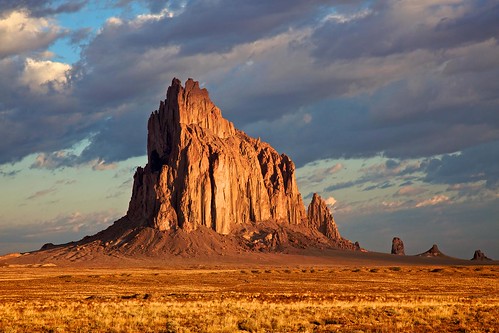
Shiprock (Navajo: Tsé Bitʼaʼí, "rock with wings" or "winged rock") is a rock formation rising nearly 1,583 feet (482.5 m) above the high-desert plain on the Navajo Nation in San Juan County, New Mexico, USA. It has a peak elevation of 7,177 feet (2,187.5 m) above the sea level. It lies about 12 by 20 miles (19 by 32 km) southwest of the town of Shiprock, which is named for the peak. Governed by the Navajo Nation, the formation is in the Four Corners region and plays a significant role in Navajo religion, mythology and tradition. It is located in the center of the Ancient Pueblo People or Ancestral Puebloan civilization, a prehistoric Native American culture of the Southwest United States often referred to as the Anasazi. Shiprock is a point of interest for rock climbers and photographers and has been featured in several film productions and novels. It is the most prominent landmark in northwestern New Mexico

Tuesday, April 19, 2011
mountain...........
The Mountain from Terje Sorgjerd on Vimeo.
This was filmed between 4th and 11th April 2011. I had the pleasure of visiting El Teide.
Spain´s highest mountain @(3718m) is one of the best places in the world to photograph the stars and is also the location of Teide Observatories, considered to be one of the world´s best observatories.
The goal was to capture the beautiful Milky Way galaxy along with one of the most amazing mountains I know El Teide. I have to say this was one of the most exhausting trips I have done. There was a lot of hiking at high altitudes and probably less than 10 hours of sleep in total for the whole week. Having been here 10-11 times before I had a long list of must-see locations I wanted to capture for this movie, but I am still not 100% used to carrying around so much gear required for time-lapse movies.
A large sandstorm hit the Sahara Desert on the 9th April (http://bit.ly/g3tsDW) and at approx 3am in the night the sandstorm hit me, making it nearly impossible to see the sky with my own eyes.
Interestingly enough my camera was set for a 5 hour sequence of the milky way during this time and I was sure my whole scene was ruined. To my surprise, my camera had managed to capture the sandstorm which was backlit by Grand Canary Island making it look like golden clouds. The Milky Way was shining through the clouds, making the stars sparkle in an interesting way. So if you ever wondered how the Milky Way would look through a Sahara sandstorm, look at 00:32.
Available in Digital Cinema 4k.
Like my Facebook Page for updates http://www.facebook.com/TSOPhotography
Follow me on http://twitter.com/TSOPhotography
Press/licensing/projects contact: terjes@gmail.com
Music by my friend: Ludovico Einaudi - "Nuvole bianche" with permission.
Please support the artist here:
http://itunes.apple.com/us/album/una-mattina/id217799399
Thank you to my sponsors:
http://www.canon.com
http://www.g-technology.com
http://www.dynamicperception.com/ (Best dolly in the world!)
Saturday, March 19, 2011
The Classic View , Monument Valley. Utah USA
Monument Valley (Navajo: Tsé Biiʼ Ndzisgaii, meaning valley of the rocks) is a region of the Colorado Plateau characterized by a cluster of vast sandstone buttes, the largest reaching 1,000 ft (300 m) above the valley floor. It is located on the southern border of Utah with northern Arizona (around 36°59′N 110°6′W), near the Four Corners area. The valley lies within the range of the Navajo Nation Reservation, and is accessible from U.S. Highway 163.

Tuesday, November 9, 2010
Iran it's beautiful
Travel Inside Iran from Flo14wer on Vimeo.
For me Iran is a beautiful, magical country, a monument for the grandor of human civilization. Iran is a place where dazzling architecture is set amid desolate expanses of desert or steppe; where snow-capped mountains plunge dramatically to a seacoast of steamy lushness; where nomads guide their flocks to seasonal pasturelands; where tombs, temples, castles, and mosques bespeak the richness of the Persian past. High and dry for the most part, the land is sectioned by great mountain ranges, dotted with venerable villages of mud and stone as well as modern cities, and has a cultural fabric woven of many different threads, Persian,Turkish, Kurdish, Baluchi, ...
Wednesday, June 2, 2010
White Sands National Monument, New Mexico , USA

White Sands National Monument, New Mexico (Photo by Walter Duke), originally uploaded by awaydotcom.
"A journey of a thousand miles must begin with a single step." -- Lao Tzu Copyright © Demetrios the Traveler
Tuesday, March 30, 2010
Oman - Mausolée de Bin Ali
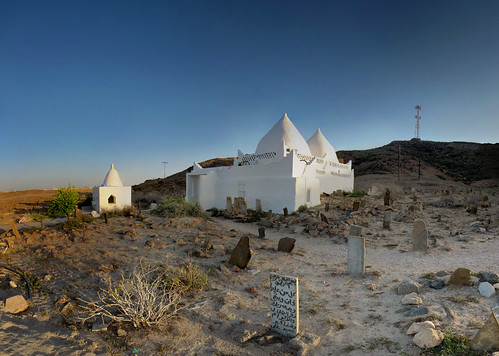
Oman’s unique story reveals examples of great moral strength, courage, heroism, maritime skills, scholarship and hard work that have together moulded the Sultanate into its present form. By drawing our attention to the noble efforts of distinguished Omanis, historians have provided us with a deeper understanding of the great wealth of human experience that is at the foundation of modern Oman.
An understanding of Oman’s place at the heart of the Middle East and its relationship with neighbouring countries is central to understanding the international position of Oman today as well as its internal dynamics.
Oman occupies the far south-eastern corner of the Arabian Peninsula, its geographical boundaries clearly defined by nature from earliest times.
The earliest Stone Age settlement discovered in Oman is in the Wattaya district and dates back more than 10,000 years.
Babylon and Assyria were among the first empires to control the Asian land trade from the Arabian Gulf to the eastern shores of the Mediterranean. Later the Persian Empire expanded to gain influence over a vast area and control the region’s trade.
The rule of the Imams in Oman began in the eighth century C.E. Ibn Masoud was elected as the first imam in 751 and his reign lasted for four centuries until 1154. The Oman of the Imams was in the Nabhan period between the thirteenth and fifteenth centuries AD; attempts to revive the Imamate in Oman were renewed in the fifteenth century but these attempts failed.
Between 1498 to 1507, after Portugal had occupied the trading ports of East Africa along with Aden, the Portuguese stranglehold, which lasted for more than a century and a half, was to fail because of Oman’s spirited resistance and the election of Imam Nasir bin Murshid to the Imamate in 1624 AD.
The Portuguese possessions in India suffered tremendously from the Omani strikes. Portuguese and Omanis engaged in bloody battles for the control of East Africa, until the entire East African shore from Mombassa to Kilwa fell under Omani control. In 1698 AD the Omanis conquered Mombassa and then entered Pemba, Zanzibar and Patta, Mozambique was the only country that resisted the Omani Arab fleet, and it stayed under Portuguese control until the twentieth century.
Despite repeated attempts from 1737-1744 AD, the Persian invasions were not to achieve their objective of subduing Oman because of the valiant resistance put up by the Omanis. Oman’s heroic resistance staved off the Persian invasion in that period and their ultimate victory is owing to the leadership of Ahmed bin Said Al-Busaidi who succeeded in ousting the Persians from Oman and was elected Imam in 1744 AD,
In 1970 His Majesty Sultan Qaboos bin Said, the Crowning Glory of Oman, inaugurated the renaissance and modern age of Oman
Copyright © Demetrios the Traveler
Wednesday, July 15, 2009
Atakama desert, Chile
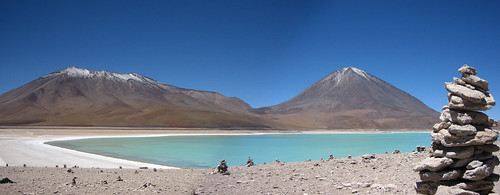
Lakes in the Atakama desert
The Atacama Desert is a virtually rainless plateau in South America, covering a 966 km (600 mi) strip of land on the Pacific coast of South America, west of the Andes mountains.
The Atacama desert is, according to NASA, National Geographic and many other publications, the driest desert in the world. The rain shadow on the leeward side of the Chilean Coast Range and the Andes, as well as a coastal inversion layer created by the cold offshore Humboldt Current, keep this over 20 million-year-old desert 50 times drier than California's Death Valley.
The Atacama occupies 181,300 square kilometers (70,000 mi²) in northern Chile, composed mostly of salt basins (salares), sand, and lava.

The Atacama is one of the driest places on Earth, and is virtually sterile because it is blocked from moisture on both sides by the Andes mountains and by the Chilean Coast Range. A coastal inversion layer created by the cold Humboldt Current, and the anticyclone of the Pacific are essential to keep the climate of the Atacama dry. The average rainfall in the Chilean region of Antofagasta is just 1 mm per year. Some weather stations in the Atacama have never received rain. Evidence suggests that the Atacama may not have had any significant rainfall from 1570 to 1971.
It is so arid that mountains that reach as high as 6,885 metres (22,590 feet) are completely free of glaciers and, in the southern part from 25°S to 27°S, may have been glacier-free throughout the Quaternary, though permafrost extends down to an altitude of 4,400 metres and is continuous above 5,600 metres. Studies by a group of British scientists have suggested that some river beds have been dry for 120,000 years.

Some locations in the Atacama do receive a marine fog known locally as the Camanchaca, providing sufficient moisture for hypolithic algae, lichens and even some cacti. But in the region that is in the "fog shadow" of the high coastal crest-line, which averages 3,000 m height for about 100 km south of Antofagasta, the soil has been compared to that of Mars. Due to its otherworldly appearance, the Atacama has been used as a location for filming Mars scenes, most notably in the television series Space Odyssey: Voyage to the Planets.
In 2003, a team of researchers published a report in Science magazine titled "Mars-like Soils in the Atacama Desert, Chile, and the Dry Limit of Microbial Life" in which they duplicated the tests used by the Viking 1 and Viking 2 Mars landers to detect life, and were unable to detect any signs in Atacama Desert soil. The region may be unique on Earth in this regard and is being used by NASA to test instruments for future Mars missions. The Team duplicated the Viking tests in Mars-like Earth environments and found that they missed present signs of life in soil samples from Antarctic dry valleys, the Atacama Desert of Chile and Peru, and other locales.
In 2008, the Phoenix Mars Lander detected perchlorates on the surface of Mars at the same site where water was first discovered. Perchlorates are also found in the Atacama and associated nitrate deposits have contained organics, leading to speculation that signs of life on Mars are not incompatible with perchlorates. Alonso de Ercilla described the desert in La Araucana, published in 1569: "Towards Atacama, near the deserted coast, you see a land without men, where there is not a bird, not a beast, nor a tree, nor any vegetation" (quoted Braudel 1984 p 388). The Atacama is also a testing site for the NASA funded Earth-Mars Cave Detection Program.
H έρημος Ατακάμα (Atacama) βρίσκεται στη Χιλή και αποτελεί μία ουσιαστικά άνυδρη πεδιάδα αποτελούμενη από λεκάνες αλάτων, άμμου και ξερής λάβας, εκτεινόμενη από τις Άνδεις έως τον Ειρηνικό Ωκεανό. Έχει ηλικία 15 εκ. ετών και είναι 100 φορές πιο ξηρή από την Κοιλάδα του Θανάτου στην Καλιφόρνια των ΗΠΑ. Η συνολική της επιφάνεια είναι 181,300 τετραγωνικά χιλιόμετρα (μεγαλύτερη της Ελλάδας). Ύψος βροχής 1mm ετησίως.

Copyright © Demetrios the Traveler
Subscribe to:
Posts (Atom)

Rising from the heart of the Tularosa Basin is one of the world's great natural wonders - the glistening white sands of New Mexico. Here, great wave-like dunes of gypsum sand have engulfed 275 square miles of desert and created the world's largest gypsum dune field.
White Sands National Monument preserves a major portion of this unique dune field, along with the plants and animals that have successfully adapted to this constantly changing environment.
source and more info: http://www.nps.gov/whsa/index.htm