Showing posts with label AEGEAN. Show all posts

Tuesday, May 25, 2010

Door to the Greek islands


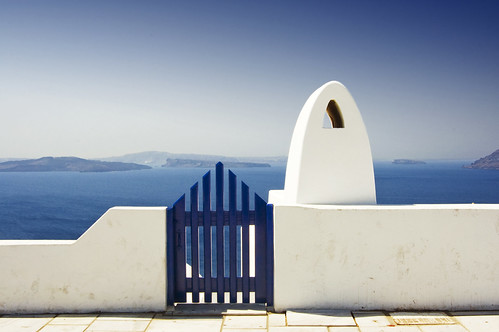
Door to the islands, originally uploaded by Wolfgang Staudt.

The Greek Islands are a collection of over 6,000 islands and islets that belong to Greece. Only 227 of the islands are inhabited, and only 78 of those have more than 100 inhabitants.
The largest Greek island by area is Crete, located at the southern edge of the Aegean Sea. The second largest island is Euboea, which is separated from the mainland by the 60m-wide Euripus Strait, and is administered as part of the central Greece periphery. After the third and fourth largest Greek Islands, Lesbos and Rhodes, the rest of the islands are two-thirds of the area of Rhodes, or smaller.
The Greek islands are traditionally grouped into the following clusters: The Argo-Saronic Islands in the Saronic gulf near Athens, the Cyclades, a large but dense collection occupying the central part of the Aegean Sea, the North Aegean islands, a loose grouping off the west coast of Turkey, the Dodecanese, another loose collection in the southeast between Crete and Turkey, the Sporades, a small tight group off the coast of Euboea, and the Ionian Islands, located to the west of the mainland in the Ionian Sea (one of these islands, Kythira, is off the southern tip of the mainland, but still considered part of the Ionian Islands).


"A journey of a thousand miles must begin with a single step." -- Lao Tzu Copyright © Demetrios the Traveler

Thursday, May 13, 2010

Kalimera visit Greece!


"A journey of a thousand miles must begin with a single step." -- Lao Tzu Copyright © Demetrios the Traveler

Wednesday, March 31, 2010

Santorini Caldera View, Greece


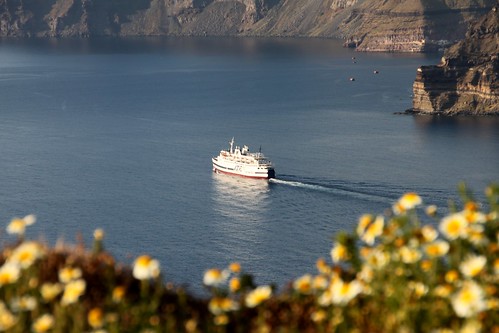
Caldera View, originally uploaded by Klearchos Kapoutsis.

Santorini (Greek: Σαντορίνη, pronounced [ˌsa(n)do̞ˈrini]) is a small, circular archipelago of volcanic islands located in the southern Aegean Sea, about 200 km (120 mi) southeast from Greece's mainland. The largest island is known as Thēra (or Thira, Greek Θήρα [ˈθira]), forming the southernmost member of the Cyclades group of islands, with an area of approximately 73 km2 (28 sq mi) and a 2001 census population of 13,670. It is composed of the Municipality of Thira (pop. 12,440) and the Community of Oía (Οία, pop. 1,230, which includes 268 inhabitants resident on the offshore island of Therasia, lying to the west). These have a total land area of 90.623 km2 (34.990 sq mi), which also includes the uninhabited islands of Nea Kameni, Palaia Kameni, Aspronisi, and Christiana (all part of the Municipality of Thira).
Santorini is essentially what remains of an enormous volcanic explosion, destroying the earliest settlements on what was formerly a single island, and leading to the creation of the current geological caldera.
A giant central lagoon, more or less rectangular, and measuring about 12 by 7 km (7.5 by 4.3 mi), is surrounded by 300 m (980 ft) high steep cliffs on three sides. The island slopes downward from the cliffs to the surrounding Aegean Sea. On the fourth side, the lagoon is separated from the sea by another much smaller island called Therasia; the lagoon merges with the sea in two places, in the northwest and southwest. The water in the centre of the lagoon is nearly 400 m (1,300 ft) deep, thus making it a safe harbour for all kinds of shipping. The island's harbours all lie in the lagoon and there are no ports on the outer perimeter of the island; the capital, Fira, clings to the top of the cliff looking down on the lagoon. The volcanic rocks present from the prior eruptions feature olivine and have a notably small presence of hornblende.[1]
It is the most active volcanic centre in the South Aegean Volcanic Arc, though what remains today is chiefly a water-filled caldera. The volcanic arc is approximately 500 km long and 20-40 km wide. The region first became volcanically active around 3-4 million years ago though volcanism on Thera began around 2 million years ago with the extrusion of dacitic lavas from vents around the region of Akrotiri.
The island is the site of one of the largest volcanic eruptions in recorded history: the Minoan eruption (sometimes called the Thera eruption), which occurred some 3,600 years ago at the height of the Minoan civilization. The eruption left a large caldera surrounded by volcanic ash deposits hundreds of feet deep and may have led indirectly to the collapse of the Minoan civilization on the island of Crete, 110 km (68 mi) to the south, through the creation of a gigantic tsunami. Another popular theory holds that the Thera eruption is the source of the legend of Atlantis.
The name Santorini was given to it by the Latin empire in the thirteenth century, and is a reference to Saint Irene. Before then it was known as Kallístē (Καλλίστη, "the most beautiful one"), Strongýlē[citation needed] (Στρογγύλη, "the circular one"), or Thēra.


"A journey of a thousand miles must begin with a single step." -- Lao Tzu
Copyright © Demetrios the Traveler


Monday, March 15, 2010

Rethymno lighthouse, Crete, Greece


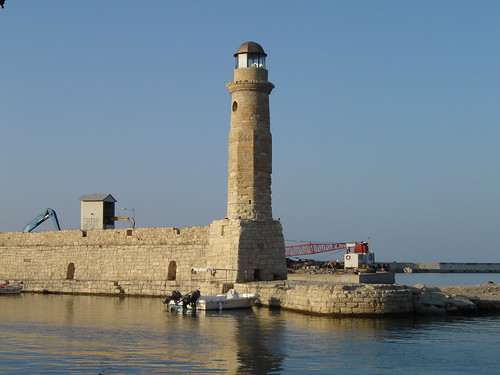
Rethymno lighthouse, originally uploaded by Glikò.

Rethymno (Greek: Ρέθυμνο, pronounced ['reθimno], also Rethimno, Rethymnon, Réthymnon, and Rhíthymnos) is a city of approximately 40,000 people in Greece, the capital of Rethymno Prefecture in the island of Crete. It was built in antiquity (ancient Rhithymna and Arsinoe), even though was never a competitive Minoan center. It was, however, strong enough to mint its own coins and maintain urban growth. One of these coins is today depicted as the crest of the town with two dolphins in a circle.
This region as a whole is rich with ancient history, most notably through the Minoan civilisation centred at Kydonia east of Rethymno.

Rethymno itself began a period of growth when the Venetian conquerors of the island decided to put an intermediate commercial station between Heraklion and Chania, acquiring its own bishop and nobility in the process. Today's old town (palia poli) is almost entirely built by Venetians. It is one of the best preserved old towns in Crete.
The town still maintains its old aristocratic appearance, with its buildings dating from the 16th century, arched doorways, stone staircases, Byzantine and Hellenic-Roman remains, small Venetian harbor and narrow streets. The Venetian Loggia today houses the information office of the ministry of culture. The Wine Festival is held there annually at the beginning of July. Another festival is held on 7-8th of November, in memory of the destruction of Arkadi Monastery.
It has a large Venetian castle called the Fortezza, one of the best preserved castles in Crete. Other monuments include the Neratze mosque (the Municipal Odeon arts centre), the Great Gate (megali porta, Porta Guora), the Piazza Rimondi (Rimondi square) and the Venetian Loggia.
As part of the Crete, the town was also captured by Turks in 1600s and ruled more than 3 centuries. Turkish version of Rethymnon is Resmo. It was sanjak centre in Crete (Girit) Province during Ottoman rule.
Today its main income is from tourism, many new facilities having been built in the past 20 years. Agriculture is also notable, especially for olive oil and other Mediterranean products. It is also the base of the Philosophical School and the University Library of the University of Crete and the School of Social and Political Sciences having 8000 students on its University Campus per annum at "Galos", where the Academic Institute of Mediterranean Studies is situated. The city has an Archaeological Museum.


"A journey of a thousand miles must begin with a single step." -- Lao Tzu
Copyright © Demetrios the Traveler


Saturday, December 12, 2009

Samos the emerald of the Aegean Sea, Greece

Samos from Chris on Vimeo.


"A journey of a thousand miles must begin with a single step." -- Lao Tzu
Copyright © Demetrios the Traveler


Digg!


Friday, October 23, 2009

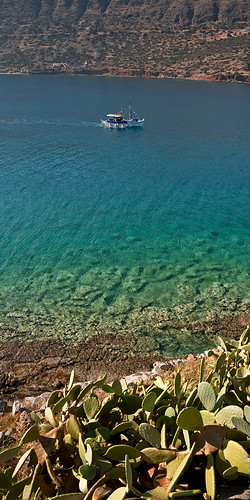
Strait,Spinalonga, Crete Greece


Strait, originally uploaded by macropoulos.


"A journey of a thousand miles must begin with a single step." -- Lao Tzu
Copyright © Demetrios the Traveler


Digg!


Wednesday, October 21, 2009

Scuba Diving in Lake Kournas, Northern Crete - Greece

I have often been to Lake Kournas and I’ve always been curious to see what the depths looked like. This video shows us the depths of the lake and the creatures living in it.
In the 3.5 minutes of video you will see crabs, a goldfish and a terrapin. The dive was shallow, so we will have to wait for another diver to reveal the secrets hidden in the deeper parts of the lake, up to 23 metres at some points. Somewhere in there may be hiding the famous water nymph of Lake Kournas, who comes out to comb her hair in the moonlight.

the diver said...


"A journey of a thousand miles must begin with a single step." -- Lao Tzu
Copyright © Demetrios the Traveler


Digg!


Tuesday, September 1, 2009

Hydra, Saronic Golf, Greece , ......Almost Noon


Almost Noon, originally uploaded by brexians election mode is ON!.

Hydra, a cosmopolitan, glorious and magnificent island,
combined with tranquility and relaxation,
offers entertainment all day long
and intensive night life.

"A journey of a thousand miles must begin with a single step." -- Lao Tzu
Copyright © Demetrios the Traveler


Digg!


Monday, August 31, 2009

Greece: Sea Sun & Culture


Greece was the first area in Europe where advanced early civilizations emerged, beginning with the Minoan civilization in Crete and then the Mycenean civilization on the mainland.

Later, city-states emerged across the Greek peninsula and spread to the shores of Black Sea, South Italy and Asia Minor reaching great levels of prosperity that resulted in an unprecedented cultural boom, expressed in architecture, drama, science and philosophy, and nurtured in Athens under a democratic environment.

Athens and Sparta led the way in repelling the Persian Empire in a series of battles.

Both were later overshadowed by Thebes and eventually Macedon, with the latter under the guidance of Alexander the Great uniting and leading the Greek world to victory over the Persians, to presage the Hellenistic era, itself brought only partially to a close two centuries later with the establishment of Roman rule over Greek lands in 146 BC.

Many Greeks migrated to Alexandria, Antioch, Seleucia and the many other new Hellenistic cities in Asia and Africa founded in Alexander's wake.

The subsequent mixture of Roman and Hellenic cultures took form in the establishment of the Byzantine Empire in 330 AD around Constantinople, which remained a major cultural and military power for the next 1,123 years, until its fall at the hands of Ottomans in 1453.

On the eve of the Ottoman era much of the Greek intelligentsia migrated to the Italian territories and much of non-Ottoman occupied Europe, playing a significant role in the Western European Renaissance through the transferring of works of Ancient Greeks to Western Europe.
Nevertheless, the Ottoman millet system contributed to the cohesion of the Orthodox Greeks by segregating the various peoples within the Ottoman Empire based on religion, as the latter played an integral role in the formation of modern Greek identity.
After the Greek War of Independence, successfully fought against the Ottoman Empire from 1821 to 1829, the nascent Greek state was finally recognized under the London Protocol. In 1827, Ioannis Kapodistrias, from Ionian Islands, was chosen as the first governor of the new Republic.

However, following his assassination, the Great Powers installed a monarchy under Otto, of the Bavarian House of Wittelsbach. In 1843, an uprising forced the King to grant a constitution and a representative assembly.

Due to his unimpaired authoritarian rule, he was eventually dethroned in 1863 and replaced by Prince Vilhelm (William) of Denmark, who took the name George I and brought with him the Ionian Islands as a coronation gift from Britain. In 1877, Charilaos Trikoupis, who is attributed with the significant improvement of the country's infrastructure, curbed the power of the monarchy to interfere in the assembly by issuing the rule of vote of confidence to any potential prime minister.

As a result of the Balkan Wars, Greece successfully increased the extent of her territory and population, a challenging context both socially and economically. In the following years, the struggle between King Constantine I and charismatic Prime Minister Eleftherios Venizelos over the country's foreign policy on the eve of World War I dominated the country's political scene, and divided the country into two opposed groups.

In the aftermath of WWI, Greece fought against Turkish nationalists led by Mustafa Kemal, a war which resulted in a massive population exchange between the two countries under the Treaty of Lausanne.

According to various sources, several hundred thousand Pontic Greeks died during this period.
Instability and successive coups d'état marked the following era, which was overshadowed by the massive task of incorporating 1.5 million Greek refugees from Asia Minor into Greek society.
The Greek population in Istanbul had shrunk from 300,000 at the turn of the century to around 3,000 in the city today.

On 28 October 1940 Fascist Italy demanded the surrender of Greece, but Greek dictator Ioannis Metaxas refused and in the following Greco-Italian War, Greece repelled Italian forces into Albania, giving the Allies their first victory over Axis forces on land. The country would eventually fall to urgently dispatched German forces during the Battle of Greece.

The German occupiers nevertheless met serious challenges from the Greek Resistance. Over 100,000 civilians died from starvation during the winter of 1941–42. In 1943 virtually the entire Jewish population was deported to Nazi extermination camps.

After liberation, Greece experienced a bitter civil war between Royalist and Communist forces, which led to economic devastation and severe social tensions between its Rightists and largely Communist Leftists for the next 30 years.

The next 20 years were characterized by marginalisation of the left in the political and social spheres but also by a significant economic growth, propelled in part by the Marshall Plan.

In 1965, a period of political turbulence led to a coup d’etat on 21 April 1967 by the US-backed Regime of the Colonels. On November 1973 the Athens Polytechnic Uprising sent shock waves across the regime, and a counter-coup established Brigadier Dimitrios Ioannides as dictator.

On 20 July 1974, as Turkey invaded the island of Cyprus, the regime collapsed.
Former premier Constantine Karamanlis was invited back from Paris where he had lived in self-exile since 1963, marking the beginning of the Metapolitefsi era. On the 14 August 1974 Greek forces withdrew from the integrated military structure of NATO in protest at the Turkish occupation of northern Cyprus.

In 1975 a democratic republican constitution was activated and the monarchy abolished by a referendum held that same year.

Meanwhile, Andreas Papandreou founded the Panhellenic Socialist Party, or PASOK, in response to Constantine Karamanlis' New Democracy party, with the two political formations dominating Greek political affairs in the ensuing decades. Greece rejoined NATO in 1980.

Relations with neighbouring Turkey have improved substantially over the last decade, since successive earthquakes hit both nations in the summer of 1999 (see Greece-Turkey earthquake diplomacy), and today Athens is an active supporter of Turkey's bid for EU membership.

Greece became the tenth member of the European Union on 1 January 1981, and ever since the nation has experienced a remarkable and sustained economic growth. Widespread investments in industrial enterprises and heavy infrastructure, as well as funds from the European Union and growing revenues from tourism, shipping and a fast growing service sector have raised the country's standard of living to unprecedented levels.

The country adopted the Euro in 2001 and successfully organised the 2004 Olympic Games in Athens.

"A journey of a thousand miles must begin with a single step." -- Lao Tzu
Copyright © Demetrios the Traveler

Tuesday, June 23, 2009

Rhodes, Greece Idyllic sunset


Rhodes(Greek: Ρόδος, Ródos, IPA: [ˈro̞ðo̞s]; Italian: Rodi; Ottoman Turkish: ردوس Rodos; Ladino: Rodi or Rodes) is a Greek island approximately 18 kilometres (11 mi) southwest of Turkey in eastern Aegean Sea. It is the largest of the Dodecanese islands in terms of both land area and population, with a population of 117,007[2] of which 53,709 resided in the homonymous capital city of the island.

Historically, Rhodes was famous worldwide for the Colossus of Rhodes, one of the Seven Wonders of the World. The medieval Old Town of the City of Rhodes has been declared a World Heritage Site. Today Rhodes is a tourist destination.

The island of Rhodes is shaped like a spearhead, 79.7 km (49.5 mi) long and 38 km (24 mi) wide, with a total area of approximately 1,400 square kilometres (541 sq mi) and a coastline of approximately 220 km (137 mi). The city of Rhodes is located at the northern tip of the island, as well as the site of the ancient and modern commercial harbours.

In the 1st century AD, the Emperor Tiberius spent a brief term of exile on Rhodes, and Saint Paul brought Christianity to the island. Rhodes reached her zenith in the third century, and was then by common consent the most civilized and beautiful city in Hellas. In 395, the long Byzantine Empire period began for Rhodes, when the Roman Empire was split and the eastern half gradually became a Greek empire. Although part of Byzantium for the next thousand years, Rhodes was nevertheless repeatedly attacked by various forces. It was first occupied by Muslim forces of Muawiyah I in 672. Much later, Rhodes was retrieved for the Byzantine Emperor Alexius I Comnenus during the First Crusade.

In 1309 the Byzantine era came to an end when the island was occupied by forces of the Knights Hospitaller. Under the rule of the newly named "Knights of Rhodes", the city was rebuilt into a model of the European medieval ideal. Many of the city's famous monuments, including the Palace of the Grand Master, were built during this period.

The strong walls which the Knights had built withstood the attacks of the Sultan of Egypt in 1444, and of Mehmed II in 1480. Ultimately, however, Rhodes fell to the large army of Suleiman the Magnificent in December 1522, long after the rest of the Byzantine empire had been lost. The few surviving Knights were permitted to retire to the Kingdom of Sicily. The Knights would later move their base of operations to Malta. The island was thereafter a possession of the Ottoman Empire for nearly four centuries.

http://en.wikipedia.org/wiki/Rhodes

Link to Kyles blog :)
http://www.metavophoto.com/blog/14-splendid-sunrise-sunset-photos/

"A journey of a thousand miles must begin with a single step." -- Lao Tzu
Copyright © Demetrios the Traveler


Digg!


Thursday, April 30, 2009

Rhodes island, Greece...


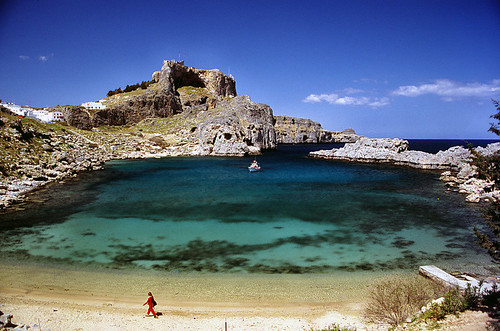
Lady in Red in Rhodes..., originally uploaded by pictalogue.
The mysterious lady in red walks through the empty beaches and lagoons of Rhodes...
The hill accross this bay carries the Acropolis of Lindos, the second largest town of Rhodes


Rhodes (GreekΡόδοςRódosItalianRodiOttoman Turkishردوس RodosLadinoRodi or Rodes) is a Greek island approximately 18 kilometres (11 mi) southwest of Turkey in eastern Aegean Sea. It is the largest of the Dodecanese islands in terms of both land area and population, with a population of 117,007of which 53,709 resided in the homonymous capital city of the island.
Historically, Rhodes was famous worldwide for the Colossus of Rhodes, one of the Seven Wonders of the World. The medieval Old Town of the City of Rhodes has been declared a World Heritage Site. Today Rhodes is a tourist destination. 


The coast line is over 220 kilometers. Rhodes is a very fertile island with rich cultivations and natural forests, especially at the South. It is famous for several agricultural products as fruits, olive oil and wine.
At the mountainous villages of the inland, there are also considerable stock-breeding and dairy products.

After a long and quite turbulent history, today the island is prosperous and famous again. It has been developed to a tourist island, offering high quality facilities and warm hospitality.
As a result it is a pole of attraction for many visitors and it is perhaps the most popular destination among the tourist resorts of Greece. Having an intense night life, it has gained in fame and many tourists come to the island to enjoy high quality amusement and nightlife for any taste.


Rhodes has been attributed several names , most of them very explicit : It has been called “ the island (or the daughter) of the sun ”, “the island of the Knights”, “the lady of the Aegean” etc.


Access to the island is possible by boat (at the central port of the town of Rhodes) and by plane (at the International Airport of Rhodes, called “Diagoras”, after the name of the famous ancient Olympic champion). There is also connection with most of the neighboring islands, as well as with the opposite Turkish coast by excursion boats.
The island of Rhodes is found at a distance of 260 nautical miles southeastern to Piraeus, with which it is connected every day by ferryboats, at least one in winter and more in summer.


The most comfortable way is of course to arrive by airplane. From El . Venizelos, the International Airport of Athens there are more than two flights to Rhodes everyday, all year round (in summer maybe more); there is also connection with Thessalonica, whereas in summer the island is connected with other cities and islands of Greece. In summer several charter flights from all around Europe are landed at the International Airport of the island.
There are also local connections, especially in summer, with several islands of the Dodecanese, of Cyclades and with Crete and the islands of the Northern Aegean, as well as with the Turkish coast across.
With in the island there is a good network of public buses that connect the capital town of Rhodes with the tourist resorts of the coast, as well as with the most important villages of the inland. Taxi is also a popular means of transportation, at least for the destinations found at short distance.

The town of Rhodes is connected daily with Lindos and Skala Kameirou by excursion boats. From Skala Kameirou excursion boats can get you to Chalki every day, or to Alimia for a short – stay excursion.


Of course, the best way to know the island is the car (rented or private). And, if you wish to go to most remote places, where cars have not access, the best way is to use a motorbike.

Popular culture

  • In ancient times there was a Roman saying: "Hic Rhodus, hic salta!" -- "Rhodes is here, here perform your jump", an admonition to prove one's idle boasts by deed rather than talk. It comes from an Aesop's fable called "The Boastful Athlete", and was cited by Hegel and Marx.
  • In the Playstation 2 game God of War II, both Rhodes and the Colossus of Rhodes are featured at the start of the game, offering a mythological theory as to how the Colossus was destroyed.

Archaeology

In ancient times, Rhodes was home to one of the Seven Wonders of the World - the Colossus of Rhodes. This giant bronze statue once stood in the harbour. It was completed in 280 BC but was destroyed in an earthquake in 224 BC. No trace of the statue remains today.
Historical sites on the island of Rhodes include the Acropolis of Lindos, the Acropolis of Rhodes, the Temple of Apollo, ancient Ialysos, ancient Kamiros, the Governor's Palace, Rhodes Old Town (walled medieval city), the Palace of the Grand MastersKahal Shalom Synagogue in the Jewish Quarter, the Archeological Museum, the ruins of the castle of Monolithos, the castle of Kritinia and St. Catherine Hospice.


"A journey of a thousand miles must begin with a single step." -- Lao Tzu
Copyright © Demetrios the Traveler


Digg!


Wednesday, April 29, 2009

a "Greek Odyssey"... the eternal voyage


Greece is full of archaeological sites and monuments of distinctive prestige and charm, on which all known periods of its long-standing history have left their mark. 
Visitors have the opportunity to make a unique “journey” through the rare “mosaic” of historic and cultural memory which has left an indelible mark on every region of the country and effortlessly highlights the manifold manifestations of Greek culture to date.
According to the UNESCO catalogue, the following archaeological sites and cultural areas in Greece have been characterised as Monuments of Cultural Heritage:

1. Monastery complex of Aghio Oros (Mount Athos)
2. The Acropolis of Athens
3. Vassae: 
The Temple of Epicurean Apollo
4. 
Vergina - Aegae
5. 
Delphi (archaeological site)
6. 
Delos (archaeological site)
7. 
Epidaurus (archaeological site)
8. Early Christian and Byzantine 
Thessalonica
9. 
Monastery complex of Meteora
10. 
Mystras (Medieval City)
11.The Monasteries of 
Daphni (Attica), Ossios Lucas (Central Greece) and Nea Moni (New Monastery) of Chios
12. The archaeological sites of Mycenae and Tiryns
13. 
Olympia (archaeological site)
14. Patmos: 
Monastery of Aghios Ioannis Theologos and the Cave of the Apocalypse
15. 
Medieval city of Rhodes
16. Samos: Pythagoreio and 
Heraion
17. 
Old Town of Corfu (Kerkyra)

For further information, click one of the specific items.

"A journey of a thousand miles must begin with a single step." -- Lao Tzu
Copyright © Demetrios the Traveler


Digg!


Friday, January 30, 2009

Go Greece for an adventure

One place where many people might not think to head for an adventure travel vacation is Greece. Situated in a cradle of civilization and bathed on three sides by one of the oldest seas on the planet, the Mediterranean, Greece offers both stunning historical and cultural experiences and a plethora of wildlife experiences.

The island is roughly 80% mountainous, so one of the most common Greece adventure travel vacations is spent rock-climbing; indeed, there are rock-climbing activities for all levels, the most popular being Meteora. Go rappelling in canyons with heights between 10 and 70 meters.

photo originaly uploaded
Trekking or walking tours through the mountains, along old mule and donkey paths or through gorges, to stop and enjoy the wildlife or the small villages is another very common activity in Greece. Adventure travel vacations here may also have a cultural immersion aspect to them and consist of a walking tour of Athens to experience the birthplace of western culture, or a walking tour aimed at visiting local wineries and indulging in food tasting activities. After all, the Mediterranean diet is one of the healthiest.

Greece boasts the world’s steepest canyon, Vikos gorge, which is a gift to trekkers that can revel in its six-hour-long trek. Go trekking through rivers lined with dense vegetation to stumble pleasantly upon hidden natural pools and waterfalls and have a swim. Visiting archeological sites and perhaps helping with digs is yet another common activity in this land which is thousands of years old. Taking in the beautiful coastlines riding along the beach on horseback, or riding through apple and chestnut trees or in Mediterranean forests, can be like riding through the world of ancient mythology.

You can enjoy camping expeditions which can involve hiking, kayaking, deep sea rafting, or canoeing, on which you will use reindeer as pack animals and marvel at the wildlife which surrounds you. Perhaps biking is what you would prefer and so can indulge in a bike tour through old, historic Greek villages, stopping off to meet some of the locals. Some agencies also offer driving tours of the Greek islands, either with or without a guide and many involve Jeep tours where travelers can experience off road adventures.

Thanks to the beautiful Mediterranean Sea, travelers can enjoy many water activities, such as sailing, in Greece. Adventure travel vacations can include sea kayaking among the Greek islands and enjoying the beautiful white rock formations, beaches and quaint Greek villages. Greek waters house an enormous variety of fauna and flora and scuba divers can enjoy underwater shipwrecks and deep sea caves. Take a motorboat cruise around the island and stop to dive into the water. Because of the wide variety of activities that this magical country has to offer, many agencies offer multi-sport vacation packages, either pre-designed to include a certain array of activities such as trekking, kayaking and scuba diving, or open to be designed by you and your adventurous mind.

If it’s Greece adventure travel vacations you want, make the Internet your first stop for information. Poke your head into a library or bookstore for books or magazines specializing in travel. Whichever of the many Greece adventure travel vacations available you choose, you’ll get transported back in time to a mythical world which you will never forget.

"A journey of a thousand miles must begin with a single step." -- Lao Tzu
Copyright © Demetrios the Traveler

Digg!


Tuesday, January 13, 2009

Piraeus the gate to Aegean ...Πειραιας, η πυλη του Αιγαιου (bilingual)


Leaving Metropolis, originally uploaded by orestis f.

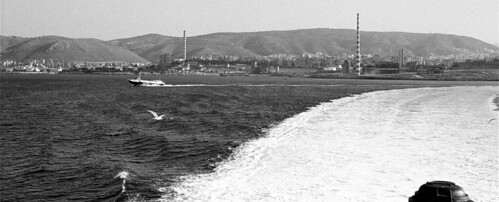
Piraeus city is the port of Athens, Greece.
Piraeus lies on Phaleron Bay, about 6 miles (10 km) southwest of Athens by highway.
The main harbour, Kántharos (ancient Cantharus), is enclosed on the west by the small Ietionía peninsula, on the south by the main Akti peninsula (the Peraïki sector of the port), and on the east by the hill of Munychia (modern Kastélla).
===================================================

Ο Πειραιάς (αρχ. Πειραιεύς), και άλλοτε Πόρτο Λεόνε ή Πόρτο Δράκο, είναι ιστορική βιομηχανική πόλη και σημαντικός λιμένας της Αττικής αλλά και της νοτιοανατολικής μεσογείου. Αποτελεί έδρα της Νομαρχίας Πειραιώς που απαρτίζεται από το χερσαίο τμήμα των οκτώ πειραιώτικων δήμων και τα νησιά του Σαρωνικού.

Ανακηρύχθηκε για πρώτη φορά δήμος το 517 π.Χ. και στα νεότερα χρόνια το 1835, σήμερα συνιστά τον τρίτο μεγαλύτερο σε πληθυσμό δήμο της χώρας.

Οι διοικητικές οντότητες που απαρτίζουν το χερσαίο τμήμα της πόλεως και περιβάλλουν το κέντρο του Πειραιά είναι η Νίκαια, ο Κορυδαλλός , το Κερατσίνι, το Πέραμα, η Δραπετσώνα, και ο Άγιος Ιωάννης Ρέντης.

Το κέντρο της πόλης απέχει περίπου 12 χιλιόμετρα από το κέντρο της Αθήνας, της οποίας και αποτελεί επίνειο ενώ συνδέεται με αυτήν με πληθώρα μέσων, λεωφορείων, τρόλλεϋ, αλλά και με τον ηλεκτρικό σιδηρόδρομο, το τραμ, τον προαστιακό σιδηρόδρομο και στο μέλλον με τις γραμμές της Αττικό Μετρό.

Ο λιμένας του Πειραιά είναι ο μεγαλύτερος της Ευρώπης και ένας από τους μεγαλύτερους του κόσμου σε επιβατική κίνηση.

Thursday, December 18, 2008

Greek islands, Aegean sea, the Greek serenity

the Greek Archipelago
the Aegean Sea,
the birthplace of civilization!


Ήλιε μου καραβοκύρη

Ξημερώνει
βάρκα μου παλιά
στο λιμάνι.
Κάθε βράδυ
βόλτα κι αγκαλιά
και σεργιάνι.

Ήλιε μου καραβοκύρη
μη ρωτάς για να σου πω
ρώτα σ’ ένα παραθύρι
τα δυο μάτια π’ αγαπώ.

Ξημερώνει
μοιάζει το νησί
με λουλούδι.
Κάθε βράδυ
γλέντι και κρασί
και τραγούδι.

Ήλιε μου καραβοκύρη...

Ξημερώνει
κρύψου στα νερά
φεγγαράκι.
Κάθε βράδυ
γέλια και χαρά
και μεράκι.

Ήλιε μου καραβοκύρη...
Νίκος Γκάτσος

"A journey of a thousand miles must begin with a single step." -- Lao Tzu
Copyright © Demetrios the Traveler


Digg!


readers

labels and tags

Powered By Blogger