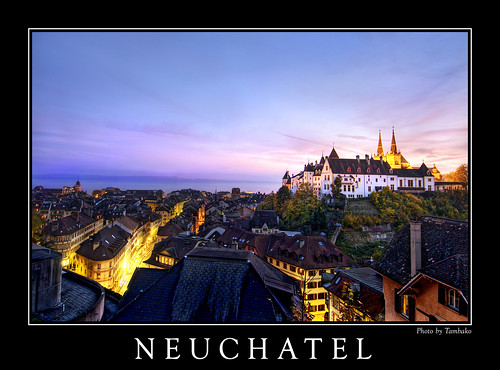
Dear Praha by Edgar Barany |
more via Wikipedia
"A journey of a thousand miles must begin with a single step." -- Lao Tzu Copyright © Demetrios the Traveler
Dear Praha by Edgar Barany |

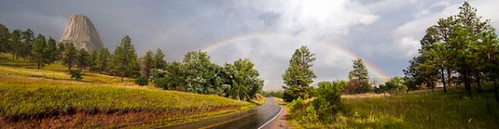
The First 50 Years In 1956, Devils Tower National Monument celebrated its 50th birthday. A Park Service historian used that occasion to record a history of Devils Tower. A big event occured in 1941 when a parachutist landed safely on top of the Tower. Getting off the Tower was the problem. (The document is rather long - CLICK for an unedited text only -- printer friendly -- version.)
Climbing Lore - Learn about the first technical climb of Devils Tower. Also, read an account of the first all-woman technical ascent of the Tower. And, how do they get up there anyhow?
Devils Tower - Sacred to Plains Tribes
A review of the ethnographic literature demonstrates that Devils Tower was a sacred area for several Plains Tribes, and that it is considered an important landmark in tribal narratives.
First Stories – In Their Own Words In the 1930’s, the importance of Devils Tower to many Plains Indians was recorded in first person narratives.
source & more info @ : http://www.nps.gov/deto/historyculture/index.htm
Between 1898 and 1906 three adjacent houses in one block on the fashionable boulevard 'Passeig de Gracia' were built by some of the most important modernist architects: Casa Amatller (designed by Puig i Cadafalch), Casa Lléo Morera (designed by Domènech i Montaner) and Gaudí's Casa Batlló.
All three houses were designed in a different interpretation of the modernist style in what seems like a competition between the architects. This lead to the local term 'Mançana de la Discordia', which means apple of discord, referring to Greek mythology where an apple, given by the goddess Eris 'to the fairest' lead to a dispute between three goddesses, eventually leading to the Trojan War. Conveniently the word mançana also means 'block', so the expression 'Mançana de la Discordia' can also be translated as 'Block of Discord'.
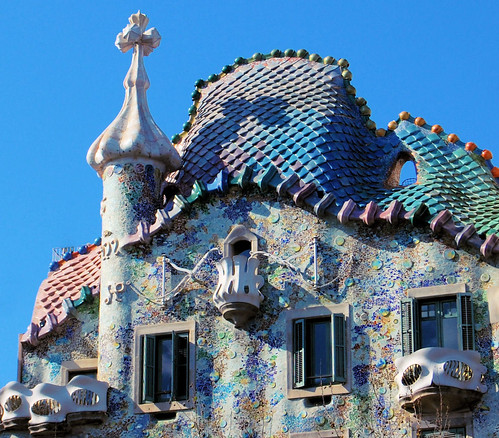
Of the three houses, Wooden door, Gaudi style Casa Batlló is the most expressive. The house was originally built between 1875 and 1877. In 1900 it was bought by the rich industrialist Josep Battló i Casanovas who commissioned Gaudí to tear down the old house and reconstruct a new one. Gaudí however convinced Battló to remodel the existing building. Between 1904 and 1906 Gaudí redesigned the facade and roof, added an extra floor and completely remodeled the interior.
The façade of the Casa Batlló is quite whimsical. It is made of sandstone covered with colorful trencadis (a Catalan type of mosaic). Typical of Gaudí, straight lines are avoided whenever possible. The first floor features irregularly sculpted oval Detail of the roofwindows. Balconies at the lower floors have bone-like pillars, those on the upper floors look like pieces of skulls. These features gave the house the nickname 'House of Bones'. The enlarged windows on the first floor gave it another nickname, 'House of Yawns'.
The colorful scaled roof recalls a reptile skin. According to some authorities on Gaudí architecture, the roof represents a dragon; the small turret with a cross would symbolize the sword of St. George stuck into the dragon. The bones and skulls on the facade represent all the dragon's victims.

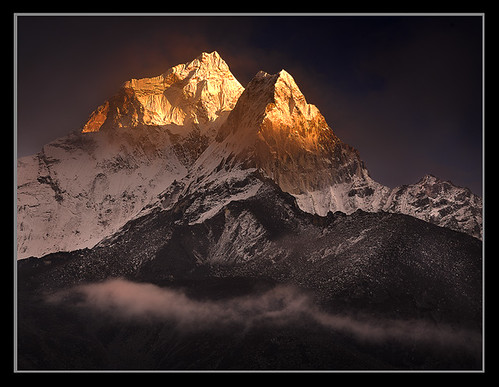
Ama Dablam is a mountain in the Himalaya range of eastern Nepal. The main peak is 6,812 metres (22,349 ft), the lower western peak is 5,563 metres (18,251 ft). Ama Dablam means "Mother's necklace"; the long ridges on each side like the arms of a mother (ama) protecting her child, and the hanging glacier thought of as the dablam, the traditional double-pendant containing pictures of the gods, worn by Sherpa women. For several days, Ama Dablam dominates the eastern sky for anyone trekking to Mount Everest basecamp.
Ama Dablam was first climbed on March 13, 1961 by Mike Gill (NZ), Barry Bishop (USA), Mike Ward (UK) and Wally Romanes (NZ) via the Southwest Ridge. They were well-acclimated to altitude, having wintered over at 5800 meters near the base of the peak as part of the Silver Hut Scientific Expedition of 1960-61, led by Sir Edmund Hillary.
Ama Dablam is the third most popular Himalayan peak for permitted expeditions. The most popular route by far is the Southwest Ridge (right skyline in the photo).
Climbers typically set up three camps along the ridge with camp 3 just below and to the right of the hanging glacier, the Dablam. Any ice that calves off the glacier typically goes left, away from the camp. However, a 2006 avalanche proved otherwise.
A climbing permit and a liaison officer are required when attempting Ama Dablam. As with Mt. Everest, the best climbing months are April-May (before the monsoon) and September-October.
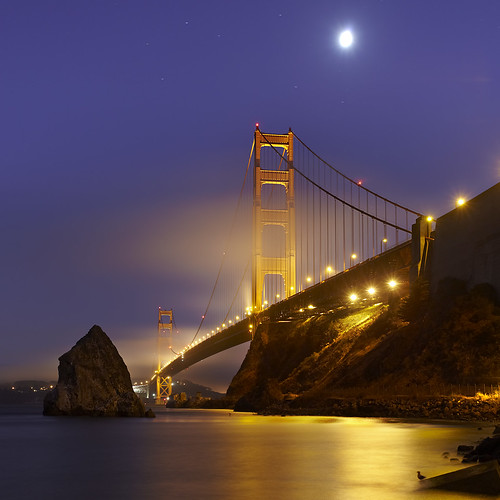
The Golden Gate Bridge is acclaimed as one of the world's most beautiful bridges and with its tremendous towers, sweeping main cables and great span, it is a sensory beauty featuring color, sound, and light. The Bridge can be a very busy place, particularly during the summer months. It is estimated that about nine million people from around the world visit the Bridge each year (1989 survey by San Francisco Convention and Visitor Bureau).
The Golden Gate Bridge, completed after more than four years of construction at a cost of $35 million, opened to vehicular traffic on May 28, 1937 at twelve o'clock noon when President Franklin D. Roosevelt pressed a telegraph key in the White House announcing the event. The GGB opening was ahead of schedule and under budget.
The Golden Gate Bridge design echoes an Art Deco Theme. Wide, vertical ribbing on the horizontal tower bracing accents the sun's light on the bridge.
The towers that support the Golden Gate Bridge's suspension cables are smaller at the top than at the base, emphasizing the tower height of 500 feet above the roadway. Irving Morrow—an architect hired by Strauss to design an architectural treatment for the bridge—chose the 'international orange' paint color to blend with the setting while still being very visible to ships.
Coit Tower is another San Francisco landmark with an Art Deco design. Timothy Pflueger was probably the most prolific and renowned Art Deco Architect in the San Francisco Bay Area.
VISIT THE BURJ KHALIFA
THE TALLEST BUILDING IN THE WORLD
We invite you to begin your Dubai sightseeing with Burj Khalifa, the tallest building in the world.
The Burj Khalifa skyscraper is a world-class destination and the magnificent centerpiece of Downtown Dubai , Dubai's new urban masterpiece.
The world's tallest building is surrounded by hotels , must-visit shopping destinations and a world of entertainment options.
The Erechtheum (Greek: Ἐρέχθειον Erechtheion) is an ancient Greek temple on the north side of the Acropolis of Athens in Greece.
The Erectheum was associated with some of the most ancient and holy relics of the Athenians: the Palladion, which was a xoanon (defined as a wooden effigy fallen from heaven - not man-made) of Athena Polias (Protectress of the City); the marks of Poseidon's trident and the salt water well (the "salt sea") that resulted from Poseidon's strike; the sacred olive tree that sprouted when Athena struck the rock with her spear in her successful rivalry with Poseidon for the city; the supposed burial places of the mythical kings Cecrops and Erechtheus; the sacred precincts of Cecrops' three daughters, Herse, Pandrosus and Aglaurus; and those of the tribal heroes Pandion and Boutes.
The temple itself was dedicated to Athena Polias and Poseidon Erechtheus. Within the foundations lived the sacred snake of the temple, which represented the spirit of Cecrops and whose well-being was thought essential for the safety of the city.
The snake was fed honey-cakes by Canephorae, the priestesses of Athena Polias, by custom the women of the ancient family of Eteoboutadae, the supposed descendants of the hero Boutes. The snake's occasional refusal to eat the cakes was thought a disastrous omen.
This is a supporting image for the "Sailing With NASA" blog, which is documenting space shuttle external tank ET-134's sea voyage from Michoud Assembly Facility in New Orleans to the Kennedy Space Center in Florida.
Credit: NASA/Carnegie-Mellon University
Read the original blog post, "Exploration May Be a Matter of Timing" --
blogs.nasa.gov/cm/blog/sailing_with_nasa/posts/post_12562...
Follow the "Sailing With NASA" blog and the ET-134 journey:
blogs.nasa.gov/cm/blog/sailing_with_nasa
HMS Beagle was a Cherokee class 10-gun brig-sloop of the Royal Navy, named after the beagle, a breed of dog. She was launched on 11 May 1820 from the Woolwich Dockyard on the River Thames, at a cost of £7,803. In July of that year she took part in a fleet review celebrating the coronation of King George IV of the United Kingdom in which she was the first ship to sail under the new London Bridge. After that there was no immediate need for Beagle so she was kept in reserve for five years and "lay in ordinary", moored afloat but without masts or rigging. She was then adapted as a survey barque and took part in three expeditions. On the second survey voyage the young naturalist Charles Darwin was on board, and his work would eventually make the Beagle one of the most famous ships in history.
Several features of the hotel required complex engineering feats to achieve. The hotel rests on an artificial island constructed 280 m (920 ft) offshore. To secure a foundation, the builders drove 230 forty-metre (130 ft) long concrete piles into the sand.
Engineers created a surface layer of large rocks, which is circled with a concrete honeycomb pattern, which serves to protect the foundation from erosion. It took three years to reclaim the land from the sea, but less than three years to construct the building itself. The building contains over 70,000 m3 (92,000 cu yd) of concrete and 9,000 tonnes of steel.
Inside the building, the atrium is 180 m (590 ft) tall.
Burj Al Arab is the world's second tallest hotel (not including buildings with mixed use). The structure of the Ryugyong Hotel in Pyongyang North Korea, is 9 m (30 ft) taller than the Burj Al Arab, and the Rose Tower, also in Dubai, topped Burj Al Arab's height at 333 m (1,093 ft), becoming the world's tallest hotel.