Showing posts with label ITALY. Show all posts

Thursday, February 9, 2012

Tenuta di Spannocchia, Tuscany, Italy

Tenuta di Spannocchia is 12th-century organic agricultural estate and educational center located just outside Siena, in central Tuscany. Spannocchia hosts a residential farm internship program and education/enrichment programs focused on Tuscan culture and history for students and adults. Learn more about our efforts to encourage global dialogue about sustaining cultural landscapes for future generations by visiting spannocchia.org
"A journey of a thousand miles must begin with a single step." -- Lao Tzu Copyright © Demetrios the Traveler

Friday, September 30, 2011

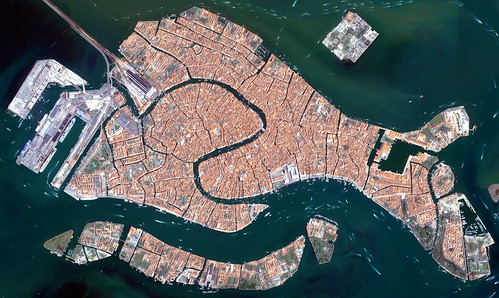
Venice Italy from space.. a Floating city


Earth From Space: Floating city, originally uploaded by europeanspaceagency.


The islands that make up the Italian city of Venice and the surrounding Venetian Lagoon are pictured in this image. Snaking through the central districts is the Grand Canal, with the Santa Lucia train station at its northern end and the Saint Mark Basin at its southern end. Zooming in, we can see water buses and taxis navigating the canal and gondolas docked along the edge. The square island to the north is San Michele. Once a prison island, it became a cemetery when Napoleon’s occupying forces declared burial on the main islands unsanitary.
This image was acquired on 22 June 2008 by Ikonos-2, a commercial satellite that provides panchromatic and multispectral high-resolution imagery. ESA is supporting Ikonos-2 as a Third Party Mission, which means that the Agency uses its multi-mission European ground infrastructure and expertise to acquire, process and distribute data from the satellite to its wide scientific user community.
High resolution versions of this image can be found at: www.esa.int/esaEO/SEM44R0UDSG_index_1.html

Wednesday, September 14, 2011

Discover the Mediterranean's Artisanal Olive Oils

Media_httpimagesnatio_oyquc

By Raphael Kadushin

Olive oil may have only recently found a firm place at the American table, next to that smug pat of butter. But in the Mediterranean, where groves of olive trees are a fixed part of the landscape, the oil has liberally infused the culture and cuisine for millennia. Now certain epicenters of the liquid gold—SpainFrance, Greece, andItaly—have witnessed a resurgence of smaller, artisanal olive oil producers that are welcoming visitors and helping fuel a local celebration of this ancient cash crop. That means travelers can map their own olive oil odyssey—one that leads from the olive estates themselves to olive oil tastings, boutiques (where the stock is bottled to clear customs), festivals, and meals overseen by an olive oil sommelier.

The 17th-century Moulin Jean-Marie Cornille (www.moulin-cornille.com) sits in Provence’s Vallée des Baux, one of France’s olive oil centers, and is considered by some chefs one of the most authentic olive mills in the country. Visit in late October and November to watch the granite millstones crush the harvest of tiny green and brown olives. Year-round, the Moulin features a film on olive oil production and a degustation of three types of the cold-pressed house specialty. Stop at the nearby boutique Jean Martin for a variety of Provençal olive oils, sauces, fig confit, and cooking classes ($26 per person).

Just below the Sierra Subbética Mountains in the southern Spanish province of Córdoba, the Núñez de Prado family (www.nunezdepradousa.com) has been producing olive oil on the single-family estate since 1795, using olives handpicked from their groves. Visitors can watch the seven varieties of estate olives get crushed in the 18th-century mill. After the demonstration, move on to a tasting (by appointment) of the organic result, roused by hints of almond, oranges, and apples, which is a favorite of the Spanish royals. The neighboring whitewashed town of Baena continues the fruity education at the Museo del Olivar y el Aceite (www.museoaceite.com), housed in its own antique mill. In November, Baena hosts an annual olive and olive oil festival that climaxes with a tapas crawl through the town’s cafés where chefs compete to serve the most creative olive-based plates.

Any olive oil quest should include Greece, where olive-leaf wreaths were the original Olympic crown and where the fruit has been cultivated for 4,000 years. The prefecture of Lakonia in south-central Peloponnese is known for the groves of Koroneiki olives that produce a fruity olive oil. The central Lakonian town of Sparta features the Museum of the Olive and Greek Olive Oil (www.piop.gr), where fossilized olive leaves from Santorini date back 60,000 years. The neighboring family-owned Olea olive oil estate (www.oleaestates.com) in the Valley of Sparta offers visitors estate tours, tastings, and excursions to the Caves of Diros.

Armando Manni was a film director before deciding to take over an ancient grove in Italy, scientifically refine olive oil production, and launch his Manni Oils(www.manni.biz)—part estate, part chemistry lab—near Montalcino, Tuscany. Working with the University of Florence to create a unique methodology called Live Oil, he produces an organic extra virgin olive oil high in antioxidant value and low in acidity. After sampling his oil (arrange tastings in advance), visitors can hike to the top of Mount Amiata for a memorable view over the olive groves and to the sea.


Monday, September 12, 2011

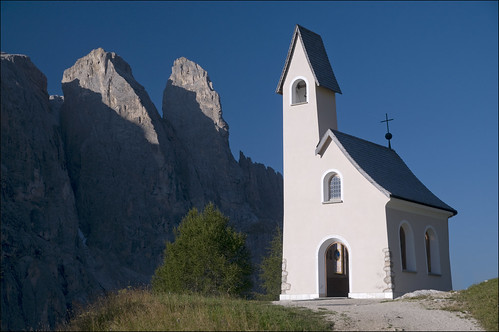
Gardena Pass S. Tyrol, Italy


Chapel of St Maurice, originally uploaded by bingleyman2.
The Gardena Pass (Italian: Passo Gardena; German: Grödnerjoch; Ladin: Ju de Frara or Jëuf de Frea) (el. 2136 m.) is a high mountain pass in South Tyrol in Italy. There are tourist accommodations on the pass itself. Walkers visit the pass to access the dramatic Dolomite mountains.
It connects Sëlva in the Val Gardena and Corvara in the Val Badia. The road over it comprises part of the famous Sella Ring, in which four linked passes (Gardena, Sella, Pordoi and Campolongo) encircle the spectacular Sella group. The route becomes busy with tourists, motorcyclists and cyclists during the summer.

Sunday, March 13, 2011

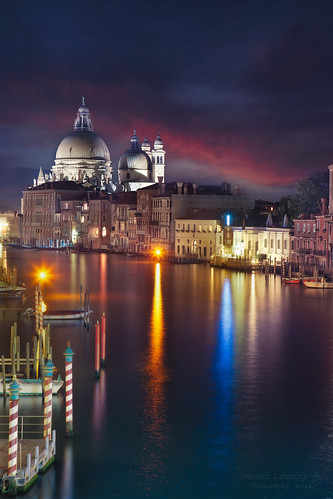
Venice Accademia , when Grand Canal is a sleep, Italy


Looking towards southern end of Grand Canal and Chiesa della Salute - Church of Santa Maria della Salute.
In October of 1630, after nearly a third of Venice's 150,000 citizens had been killed by plague, the Venetian Senate made an offer to God: "Stop the plague, and we'll build a church to honor the Virgin Mary."
I was looking for something for the competition and the subject is “ Night “ and I wondered off to Venice. It seams that every time I open files from Venice I find something that I missed before.
What I miss the most it the Venice itself. I would love to go back

Tuesday, March 8, 2011

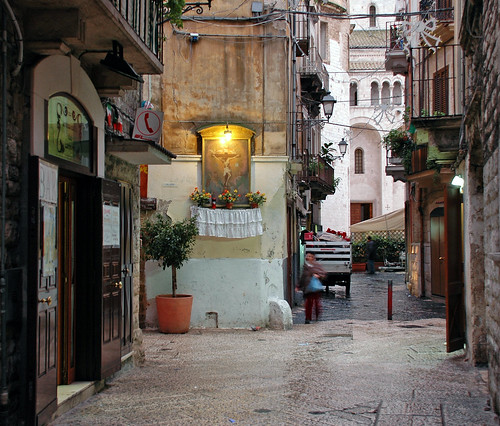
Bari Antica... Italy


Bari (Italy) - Bari Antica, originally uploaded by Danielzolli.

A typical narrow street in the old town of Bari (Bari Antica). There's a lot of illuminated figures of holy figures and other private sanctuaries. Often the houses in these streets have no real doors, instead a curtain leads directly to the living room, which serves also as a parking lot for the Vespa. With such tiny streets it's not easy to orientate - but not too hard either, since the old town is surrounded by the sea on three sides.

Monday, May 10, 2010

Mount Etna, Sicily - Italy

Mount Etna (Αἴτνη (Aítnē) in Classical Greek, Aetna in Latin, also known as Muncibeddu (beautiful mountain) in Sicilian and Mongibello in Italian (from the Latin mons and the Arabic gibel, both meaning mountain) is an active stratovolcano on the east coast of Sicily, close to Messina and Catania. Its Arabic name was Jebel Utlamat (the Mountain of Fire). According to Adrian Room’s book Placenames of the World, the name Etna is said to have originated from a Phoenician word attuna meaning “furnace.” He dismisses the theory that Etna is from a Greek source meaning “I burn.” It is the largest active volcano in Europe, currently standing 3,329 metres (10,922 ft) high, though this varies with summit eruptions; the mountain is 21 m (69 ft) lower now than it was in 1981. It is the highest mountain in Italy south of the Alps. Etna covers an area of 1,190 km² (460 sq mi) with a basal circumference of 140 km. This makes it by far the largest of the three active volcanoes in Italy, being about two and a half times the height of the next largest, Mount Vesuvius. Only Mount Teide in Tenerife surpasses it in the whole of the European region (though geographically Tenerife is an island of Africa). In Greek Mythology, the deadly monster Typhon was trapped under this mountain by Zeus, the god of the sky.
Mount Etna is one of the most active volcanoes in the world and is in an almost constant state of activity. The fertile volcanic soils support extensive agriculture, with vineyards and orchards spread across the lower slopes of the mountain and the broad Plain of Catania to the south. Due to its history of recent activity and nearby population, Mount Etna has been designated a Decade Volcano by the United Nations.

"A journey of a thousand miles must begin with a single step." -- Lao Tzu Copyright © Demetrios the Traveler

Sunday, May 9, 2010

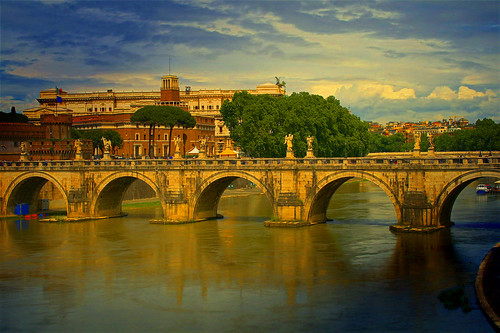
bridge to Vatican, Rome, Italy


bridge to Vatican in HDR, originally uploaded by monsteratu.

Vatican City, officially the State of the Vatican City (Italian: Stato della Città del Vaticano, pronounced is a landlocked sovereign city-state whose territory consists of a walled enclave within the city of Rome, the capital city of Italy. It has an area of approximately 44 hectares (110 acres), and a population of just over 800.
Vatican City was established in 1929. It is distinct from the Holy See, which dates back to early Christianity and is the main episcopal see of 1.147 billion Latin and Eastern Catholic adherents around the globe. Ordinances of Vatican City are published in Italian; official documents of the Holy See are issued mainly in Latin. The two entities even have distinct passports: the Holy See, not being a country, only issues diplomatic and service passports; the state of Vatican City issues normal passports. Very few passports are issued by either authority.
The Lateran Treaty in 1929, which brought the city-state into existence, spoke of it as a new creation (Preamble and Article III), not as a vestige of the much larger Papal States (756-1870) that had previously encompassed central Italy. Most of this territory was absorbed into the Kingdom of Italy in 1860, and the final portion, namely the city of Rome with a small area close to it, ten years later, in 1870.
Vatican City is an ecclesiastical or sacerdotal-monarchical[6] state, ruled by the bishop of Rome—the Pope. The highest state functionaries are all Catholic clergymen of various nationalities. It is the sovereign territory of the Holy See (Sancta Sedes) and the location of the Pope's residence, referred to as the Apostolic Palace.
The Popes have resided in the area that in 1929 became Vatican City since the return from Avignon in 1377. Previously, they resided in the Lateran Palace on the Caelian Hill on the opposite side of Rome, which site Constantine gave to Pope Miltiades in 313. The signing of the agreements that established the new state took place in the latter building, giving rise to the name of Lateran Pacts, by which they are known.


"A journey of a thousand miles must begin with a single step." -- Lao Tzu Copyright © Demetrios the Traveler

Tuesday, March 30, 2010

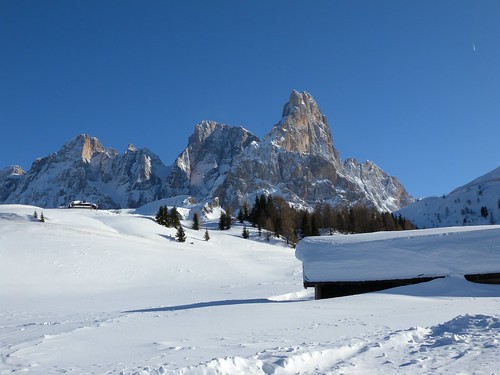
San Martino di Castrozza, ITALY

A tourist mecca, the Dolomites are famous for skiing in the winter months and mountain climbing, daily excursions, climbing and Base Jumping, as well as paragliding and hang gliding in summer and late spring/early autumn.[citation needed] Free climbing has been a tradition in the Dolomites since 1887, when 17-year-old Georg Winkler soloed the first ascent of the pinnacle Die Vajolettürme. The main centres include: Rocca Pietore alongside the Marmolada glacier, which lies on the border of the Trentino-Alto Adige/Südtirol and Veneto regions, the small towns of Alleghe, Falcade, Auronzo, Cortina d'Ampezzo, and the villages of Arabba, Urtijëi and San Martino di Castrozza, as well as the whole of the Fassa, Gardena and Badia Valleys.
In the first week in July, the Maratona dles Dolomites, an annual single-day road bicycle racing race covering seven mountain passes of the Dolomites, is staged.

"A journey of a thousand miles must begin with a single step." -- Lao Tzu
Copyright © Demetrios the Traveler


Friday, October 30, 2009

Galleria - Vittorio Emanuele II, Milan Italy

Nel 1865 iniziarono i lavori con la posa della prima pietra da parte di re Vittorio Emanuele II di Savoia e due anni più tardi si inaugurò la Galleria, anche se non completamente terminata. Circa dodici anni dopo finalmente il complesso fu terminato.

Giuseppe Mengoni, l'ideatore della Galleria, vi morì proprio precipitando dalla cupola durante un'ispezione il 30 dicembre 1877, anche se non mancò l'interpretazione che si trattasse di un suicidio, dovuto alle critiche espresse da più parti e alla delusione per la mancata presenza del re all'inaugurazione. Non si poteva sapere che tale assenza era dovuta alle gravi condizioni di salute di Vittorio Emanuele II, tenute segrete, e che il re sarebbe morto dopo pochi giorni.


"A journey of a thousand miles must begin with a single step." -- Lao Tzu
Copyright © Demetrios the Traveler


Digg!


Tuesday, September 15, 2009

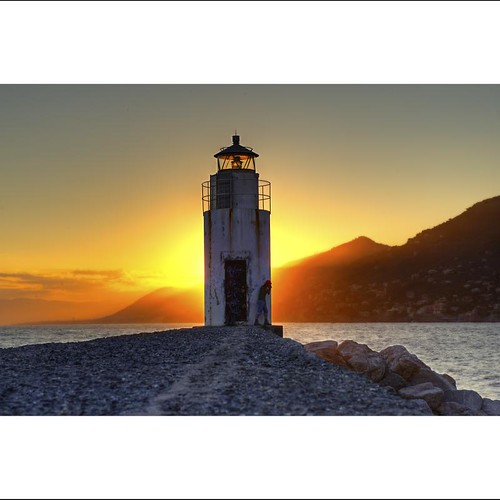
Lighthouse inferno, Camogli Italy.


Lighthouse inferno, originally uploaded by GadiHext.

CAMOGLI – 2km southeast of Recco – was the "saltiest, roughest, most piratical little place", according to Dickens when he visited in 1884. It's had its rough edges knocked off since then, and is one of the most attractive small resorts along this stretch of the coast, well connected by road, rail and boat. The town's name, a contraction of Casa Mogli (House of Wives), comes from the days when voyages lasted for years and the women ran the port while the men were away. In its day, Camogli supported a huge fleet of 700 vessels, which once saw off Napoleon. The town declined in the age of steam, but the crumbling arcades by the harbour and the dark flight of steps into the town centre still have the "smell of fish, and seaweed, and old rope" that Dickens relished.

The train station is just south of the beach; turn right towards the centre for the small tourist office, 50m north at Via XX Settembre 33 (Mon–Sat 8.30am–noon & 3–7pm, Sun 9am–1pm; tel 0185.771.066, www.camogli.it). Summer boats shuttle over from Genoa's Porto Antico in an hour (8), using the old harbour on the north side of town, separated from the unimpressive pebble beach to the south by a promontory occupied by the medieval Castello della Dragonara. You can wander up through the alleyways to the castle, though the aquarium it houses is currently closed for renovation.

The best hotel is the lavish Cenobio dei Dogi, in its own waterfront park at Via Cuneo 34 (tel 0185.7241, fax 0185.772.796; 160–200); once the summer palace of Genoa's doges, it boasts its own beach, pool, tennis courts, restaurants and tasteful guest rooms. La Camogliese, Via Garibaldi 55 (tel 0185.771.402, fax 0185.774.024; 50–65), is a friendly spot excellently situated by the water (take the steps down opposite the station); it has pleasant rooms and they don't insist on full pension. Otherwise, try the spartan Selene, Via Cuneo 15 (tel 0185.770.149, fax 0185.770.195; 35–50). The Camogliese hotel has a quality mid-priced restaurant (closed Wed in winter). The much pricier Vento Ariel on the harbourfront (tel 0185.771.080; closed Wed) serves only fish brought that day directly from the nets into the kitchen. Away from the sea, Don Ricardo on Salita Priaro (the flight of steps up from the fishing harbour) does affordable Mexican food, and Revello is a fine bakery at Via Garibaldi 183.

Fish aside, Camogli makes its living from ferries operated by Golfo Paradiso, Via Scalo 3 (tel 0185.772.091). Departures to tranquil Punta Chiappa, ideal for a spot of swimming and basking in the sun, and San Fruttuoso, are most frequent (May–Sept at least hourly; Oct–April 3 weekdays, hourly at weekends), with a special night excursion offering the most romantic views of the gulf plus three hours in San Fruttuoso for dinner or a stroll (July & Aug 3 weekly; 9 return). There are also boats east to the Cinque Terre (July–Sept 2–4 weekly), which stop beforehand at Portofino and continue to Portovénere, as well as plenty more west to Recco and Genoa.


"A journey of a thousand miles must begin with a single step." -- Lao Tzu
Copyright © Demetrios the Traveler


Digg!


Tuesday, August 4, 2009

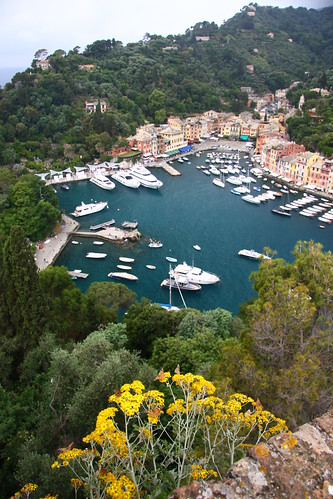
Portofino Italy one of the oldest vacation destination


According to Pliny the Elder, Portofino was founded by the Romans and named Portus Delphini, or Port of the Dolphin, because of the large number of dolphins that inhabited the Tigullian Gulf.
Portofino bay.

The village is mentioned in a diploma from 986 by Adelaide of Italy, which assigned it to the nearby Abbey of San Fruttoso di Capodimonte. In 1171, together with the neighbouring Santa Margherita Ligure, it was included in Rapallo's commune jurisdiction. After 1229 it was part of the Republic of Genoa. The town's natural harbour supported a fleet of fishing boats, but was somewhat too cramped to provide more than a temporary safe haven for the growing merchant marine of the Republic of Genoa.

In 1409 Portofino was sold to the Republic of Florence by Charles VI of France, but when the latter was ousted from Genoa the Florentine gave it back. In the 15th century it was a fief of families such as the Fieschi, Spinola, Adorno and Doria.

In 1815 it became part of the Kingdom of Sardinia and, from 1861, of the unified Kingdom of Italy.

In the late 19th century, first British, then other northern European aristocratic tourists began to visit Portofino, which they reached by horse and cart from Santa Margherita Ligure. Aubrey Herbert (1880–1923) was one of the more famous Englishmen to maintain a villa at Portofino. Eventually more expatriates built expensive vacation houses, and by 1950 tourism had supplanted fishing as the town's chief industry, and the waterfront was a continuous ring of restaurants and cafés.

thanks to:
en.wikipedia.org/wiki/Portofino

"A journey of a thousand miles must begin with a single step." -- Lao Tzu
Copyright © Demetrios the Traveler


Digg!


Friday, June 12, 2009

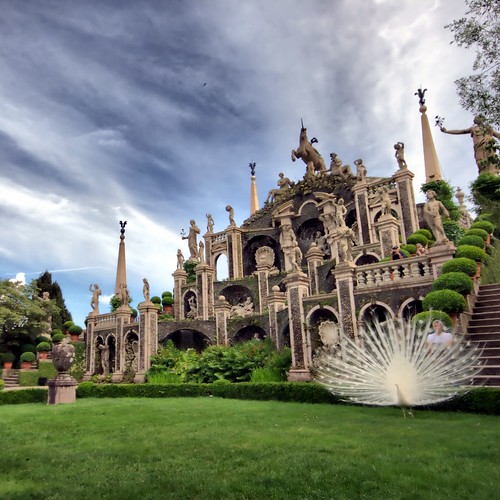
Isola Bella (Italy)

©Angela M. Lobefaro
DO NOT Download or use my photos without my written permission.

Shot taken by Max in Turin, during Gadi's gadihext great 10 days visit in Italy! Thanks so much Gadi and Smadar for your kind visit!!
We enjoyed your company in Italy!

Isola Bella is one of the Borromean Islands of Lago Maggiore in north Italy. The island is situated in the Borromean Gulf 400 meters from the lakeside town of Stresa. Isola Bella is 320 meters long by 400 meters wide and is entirely occupied by the Palazzo Borromeo and its Italianate garden.

History

Until 1632 the island—known only as l’isola inferiore or isola di sotto[1]—was a rocky crag occupied by a tiny fishing village: but that year Carlo III of the influential House of Borromeo began the construction of a palazzo dedicated to his wife, Isabella D'Adda, from whom the island takes its name. He entrusted the works to the Milanese Angelo Crivelli, who was also to be responsible for the planning the gardens. The works were interrupted around middle of the century when the Duchy of Milan was struck by a devastating outbreak of the plague.

Construction resumed when the island passed to Carlo’s sons, Cardinal Giberto III (1615-1672) and Vitaliano VI (1620-1690); the latter in particular, with the financial backing of his elder brother, entrusted the completion of the works to the Milanese architect Carlo Fontana and turned the villa into a place of sumptuous parties and theatrical events for the nobility of Europe.

The completion of the gardens, however, was left to his nephew Carlo IV (1657 -1734). They were inaugurated in 1671.

The island achieved its highest level of social success during the period of Giberto V Borromeo (1751 – 1837) when guests included Edward Gibbon, Napoleon and his wife Joséphine de Beauharnais, and Caroline of Brunswick, the Princess of Wales. It is said that Caroline, having fallen in love with the place, did her best to convince the Borromeo family to sell her Isola Madre or the Castelli di Cannero islands; in the event she established herself on the banks of Lake Como at Cernobbio in the Villa d’Este.

en.wikipedia.org/wiki/Isola_Bella_(Lago_Maggiore)


"A journey of a thousand miles must begin with a single step." -- Lao Tzu
Copyright © Demetrios the Traveler


Digg!


Saturday, May 30, 2009

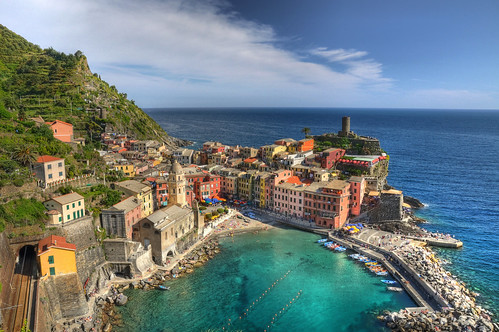
Vernazza


Vernazza, originally uploaded by Digitaler Lumpensammler.

From Wikipedia, the free encyclopedia

Vernazza is a town and commune located in the province of La Spezia, Liguria, northwestern Italy. It is one of the five towns in the Cinque Terre region.
Vernazza is the fourth town heading north into the Cinque Terre. It has no car traffic (a road leads into a parking lot on the edge of the town) and remains one of the truest "fishing villages" on the Italian Riviera.

Main sights
Church of Santa Margherita d'Antiochia, begun in 1318. It has a nave and two aisles with an octagonal bell tower rising from the apse area.
Doria Castle
Shrine of Santuario di Nostra Signora di Reggio, about a half hour's steep walk above Vernazza. The wide path that leads up to the shrine is punctuated with the Stations of the Cross. Around the shrine is a large shady open area, expansive views of the water below, as well as the hillside vineyards, and various statues of Mary and Joseph.
The Beach in the protected harbor on the northwestern side.

"A journey of a thousand miles must begin with a single step." -- Lao Tzu
Copyright © Demetrios the Traveler


Digg!


Sunday, May 17, 2009

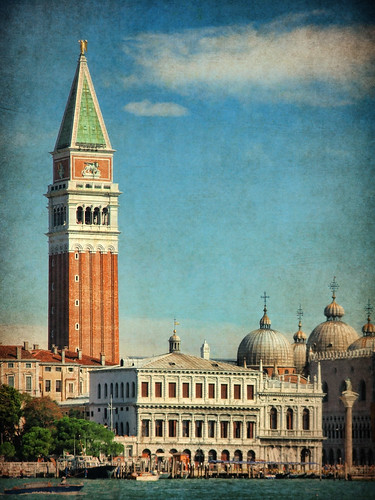
St Mark's Campanile, Venice

St Mark's Campanile (Campanile di San Marco in Italian) is the bell tower of St Mark's Basilica in Venice, Italy, located in the square (piazza) of the same name. It is one of the most recognizable symbols of the city.

The tower is 98.6 meters tall, and stands alone in a corner of St Mark's Square, near the front of the basilica. It has a simple form, the bulk of which is a plain brick square shaft, 12 meters a side and 50 meters tall, above which is the arched belfry, housing five bells. The belfry is topped by a cube, alternate faces of which show walking lions and the female representation of Venice (la Giustizia: Justice). The tower is capped by a pyramidal spire, at the top of which sits a golden weathervane in the form of the archangel Gabriel. The campanile reached its present form in 1514. As it stands today, however, the tower is a reconstruction, completed in 1912 after the collapse of 1902.


"A journey of a thousand miles must begin with a single step." -- Lao Tzu
Copyright © Demetrios the Traveler


Digg!


Monday, April 27, 2009

Castello Banfi, Tuscany, Italy


Castello Banfi appears on the Tuscan horizon like a pink hilltop castle      straight out of a fairy tale. A tall, slender Rapunzel-style tower overlooks a huge estate that reaches almost as far as the nearby Mediterranean. Within this authentic medieval fortress lies a cozy courtyard; outside lies a cluster of stone cottages with narrow vine-covered streets, a hamlet that clung to the castle walls in the dark ages. The estate holds vines, olive groves, wheat fields, plum orchards, and woodlands; within those same forests live wild boar, deer, pheasant, even truffles.
   But unlike many European winery castles, this place is no fortress when it comes to visitors. It has two restaurants, one of which has a Michelin star. It has a gorgeous wine store with spacious ceramic flooring, handsome dark wood rafters, and attractive display shelves. The winery facilities with their endless rows of barrels are immaculate, as are the 14 guest rooms located in the surrounding stone cottages.


The winery even has its own onsite cooperage, where the best oak planks from France and Slavonia are custom made into barrels. If this isn't quite enough, what surely marks this winery out as a must-see in southern Tuscany is its intriguing Glass Museum, six rooms displaying glass from the present day all the way back to the 15th century B.C. Egyptian urns sit beside Babylonian vases beside ancient Roman ampules and goblets; present-day examples include decorative crystal by some guys called Picasso, Cocteau, and Dalí. It focuses your mind temporarily away from the wine onto the see-through object that holds it.


Such rich, historic splendor has its genesis in the most unlikely of places -- Long Island, New York. This is where owner John F. Mariani's father started out with an Italian wine importer called Banfi in 1919. His timing could not have been worse -- Prohibition came a year later. He limped through those dry years selling wine for "medicinal purposes," then wasted no time importing the very best from Italy when the law was finally lifted. Business boomed, and over the years Banfi introduced the finest of Italian wines to the American market, including Lambrusco, and Chianti.

The winery itself has put its faith in Sangiovese; vineyards teeming with the grape now besiege the castle walls. While the whole complex has a somewhat polished, corporate feel, rest assured that this is no Disneyland of wine -- it's the genuine article.


Contact Information:
Castello Banfi, Montalcino; tel. 39/577/840111www.castellobanfi.com.


"A journey of a thousand miles must begin with a single step." -- Lao Tzu
Copyright © Demetrios the Traveler


Digg!


the ultimate fate of Venice

Posted by Picasa

Sitting as it does on top of the water, Venice has always been vulnerable to flooding. In the 20th century, though, flooding began to look like a permanent possibility when the city started to sink. Now, entering the 21st century, Venice is no longer sinking--instead, the sea around it is rising.
Across the Venice Lagoon from the ancient city are the modern industrial cities of Mestre and Marghera. In the years following World War I, these cities began pumping water out of the ground underneath Venice to supply their growing populations. As the ground water was drained, the soil began to settle under the weight of the city above it.
Before the Italian government came to the rescue in 1973, Venice had sunk by as much as a foot. Two aqueducts were built to supply Venice's neighbors with water from the country's interior, and the sinking stopped.Unfortunately, whether due to the greenhouse effect or global climatic trends, water levels around the world are rising.
At the current rate, scientists say the Adriatic Sea around Venice could rise three feet over the next 100 years--which would be catastrophic for Venice.There's little Venice can do to prevent the sea from rising. However, to keep the city's buildings and streets dry during high autumn and winter tides, scientists have proposed Project Moses, which would install underwater barriers between the islands separating the lagoon from the Adriatic. These barriers could rise to block incoming waves. Environmentalists, however, fear that the barriers would disrupt the lagoon's ecology.
Charles Dickens once described the Venice Lagoon as an old serpent, "noiseless and watchful: coiled round and round." Only time will tell if the old serpent will ultimately swallow Venice whole.


"A journey of a thousand miles must begin with a single step." -- Lao Tzu
Copyright © Demetrios the Traveler


Digg!


Saturday, March 21, 2009

Nervi, Riviera Levante, Italy

Nervi is a former fishing village , now a seaside resort in Liguria, in northwest Italy. Once an independent comune, it is now a quartiere of Genoa. 

Nervi is 7km east of central Genoa.
Located 25 meters above sea level, Nervi is the oldest winter resort on the Riviera di Levante, the part of the Italian Riviera east of Genoa. 

At the beginning of the century, it's mentioned as being surrounded with groves of olives, oranges and lemons, and beautiful gardened villas. The climate is moist and less dusty than the Riviera di Ponente, the part of the Italian Riviera west of Genoa, and is especially in favor with those who suffer from lung complaints.

from wikipedia
en.wikipedia.org/wiki/Nervi

Monday, February 16, 2009

Venice carnival Το καρναβαλι της Βενετιας


"A journey of a thousand miles must begin with a single step." -- Lao Tzu
Copyright © Demetrios the Traveler


Digg!


Saturday, January 10, 2009

Venice an abstract ...αιωνια Βενετια

"Eternal Venice sinking by degrees
Into the very water that she lights;"

Edgar Bowers (b. 1924), U.S. poet. 
The Stoic: for Laura von Courten (l. 19-20).


"A journey of a thousand miles must begin with a single step." -- Lao Tzu
Copyright © Demetrios the Traveler


Digg!


readers

labels and tags

Powered By Blogger