Sunday, March 7, 2010

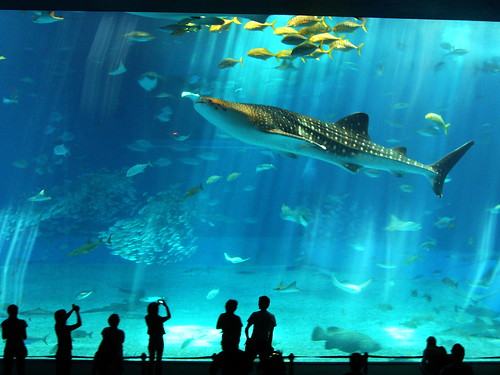
Okinawa Churaumi Aquarium, Japan


big swim, originally uploaded by anzyAprico.

The aquarium is a part of the Ocean Expo Commemorative National Government Park located in Motobu, Okinawa. The aquarium is made up of four-floors which hold attractions of deep sea creatures, sharks, coral and other tropical fish. The aquarium is set on 19,000 m² of land, holds a total of 77 tanks with 10,000 m³ of water. Water for the saltwater exhibits is pumped into the aquarium from 350m offshore 24 hours a day.
The main tank called the 'Kuroshio Sea' holds 7,500-cubic meters (1,981,290 gallons) of water and features the world's second largest acrylic glass panel, measuring 8.2 meters by 22.5 meters with a thickness of 60 centimeters. Whale sharks and manta rays are kept amongst many other fish species in the main tank.
On 16 June 2007 at 10:25 PM a manta ray was born at the aquarium after a gestation of 374 days.
The aquarium holds 80 species of coral and is one of very few that keep whale sharks in captivity, and is currently trying to breed them.


"A journey of a thousand miles must begin with a single step." -- Lao Tzu
Copyright © Demetrios the Traveler


Digg!


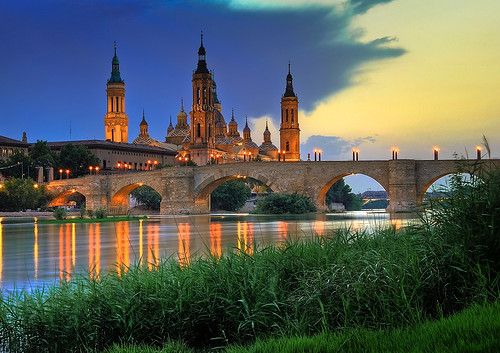
Basilica del Pilar,@ River "Ebro", Zaragoza. Spain,


Basilica del Pilar, sunset, originally uploaded by Paulo Brandão.

The Basilica-Cathedral of Our Lady of the Pillar (in Spanish Catedral-Basílica de Nuestra Señora del Pilar) is a Roman Catholic church in the city of Zaragoza, Aragon in Spain.
The Basilica venerates Blessed Virgin Mary , under her title Our Lady of the Pillar praised as Mother of the Hispanic Peoples by Pope John Paul II. I
t is reputed to be the first church dedicated to Mary in history.
Local traditions take the history of this basilica to the dawn of Christianity in Spain attributing to an apparition to St James the greater, an Apostle who had brought Christianity to the country. This is the only known apparition of Mary to have occurred before her Assumption.
Many of the kings of Spain, many other foreign rulers and saints have paid their devotion before this statue of Mary. St. John of the Cross, St. Teresa of Avila, St. Ignatius of Loyola, and Blessed William Joseph Chaminade are among the most outstanding ones.
The Basilica of Our Lady of the Pillar is one of two minor basilicas in the city of Zaragoza, and is co-cathedral of the city alongside the nearby La Seo Cathedral. The architecture is of baroque style, and the present building was predominantly built between 1681 and 1872.


"A journey of a thousand miles must begin with a single step." -- Lao Tzu
Copyright © Demetrios the Traveler


Digg!


Rothenburg ob der Tauber, Bavaria Germany

Rothenburg ob der Tauber, a town in Middle Franconia (Germany, Bavaria), is the Plönlein.
To the left you see the Siebersturm and to the right the Kobolzeller gate. You can walk down to the gate in the direction of the Tauber valley. If you have time, you should walk through the gate, because from there you have a magnificent cityscape to the southern of Rothenburg. The Plönlein with the half-timbered house is probably the best known motif and is photographed hundreds of times by tourists daily.
The name "Plönlein" comes from Latin (planum) and means level/lowlands.


"A journey of a thousand miles must begin with a single step." -- Lao Tzu
Copyright © Demetrios the Traveler


Digg!


Fire Island Lighthouse, Long island NY USA


Fire Island Lighthouse, originally uploaded by Ronaldo F Cabuhat.

We were in NYC but was still cold for a walk in Central Park.
We drove through Long Is, NY and ended up on this enchanting island. (More pics to come!)

This lighthouse is a 167 foot Stone tower that began operation in 1858 to replace the 89 foot tower originally built in 1827.

I think this is the building where one scene(beginning portion) in
"National Treasure 2 : Book Of Secrets " ( starring Nicolas Cage, Justin Bartha, Diane Kruger, Jon Voight, Helen Mirren and Ed Harris) was shot.
The scene at the mail office (supposedly in a Massachusetts town).


"A journey of a thousand miles must begin with a single step." -- Lao Tzu
Copyright © Demetrios the Traveler


Digg!


Medieval Castle Het Steen - Antwerp, Belgium

Het Steen is a historic medieval castle in the old city center of Antwerp, Belgium, one of Europe's biggest ports. Built in 1200 - 1225, Het Steen is Antwerp's oldest building.
Previously known as Antwerp Castle, Het Steen gained its current name in around 1520, after significant rebuilding under Charles V. The rebuilding led to it being known first as "'s Heeren Steen" (the King's Stone), and later simply as "Het Steen" (The Stone). The Dutch word "Steen" means "stone", and is used for "castle" or "fortress", as in the "Gravensteen" in Ghent, Belgium.
The castle made it possible to control the access to the Schelde, the river that flows through Antwerp. It was also used as a prison between 1303 and 1827. This was not the noblest time of existence of the Steen Castle. Captivity itself was not punishment - the prison was where you awaited your sentence. Very popular punishment available was; chopping of hands, heads and/or burning and quartering. The prison’s regime was not a very honest one. The rich were logged in the right wing and the poor in the left wing of the castle.
Part of the castle was later demolished to make the roads to connect the south and the north part of the port. The remaining building contains a shipping museum, with outside on displayed on the quay, some real old canal barges.
In 1890 ‘Het Steen’ became the museum of archeology and in 1952 an annex was added to house the museum of the Antwerp maritime history. Here you’ll also find a war memorial to the Canadian soldiers in WWII.
At the entrance to Het Steen is a bas-relief of Semini, above the archway, circa 2nd century. Semini is the Scandinavian God for youth and fertility (with symbolic phallus). A historical plaque near Het Steen explains that women of the town appealed to Semini when they desired children; the god was reviled by later religious clergy. Inhabitants of Antwerp previously referred to themselves as "children of Semini". An organization affiliated with historic preservation of Het Steen and Semini, Antwerp Komitee Semini in Ere (AKSIE), formed in 1986, holds annual celebrations at Het Steen as cultural events. (Source: Het Steen)


"A journey of a thousand miles must begin with a single step." -- Lao Tzu
Copyright © Demetrios the Traveler


Digg!


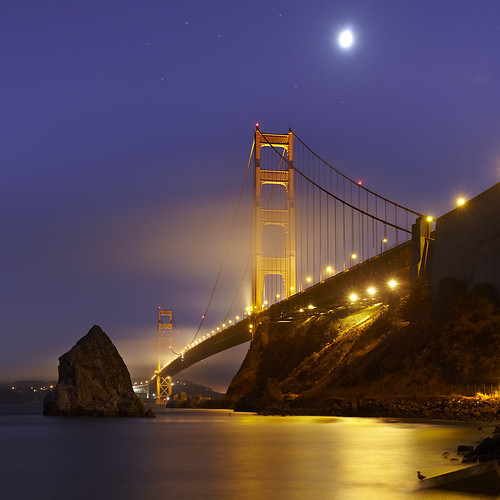
Golden Gate Bridge, SF, USA

The Golden Gate Bridge is acclaimed as one of the world's most beautiful bridges and with its tremendous towers, sweeping main cables and great span, it is a sensory beauty featuring color, sound, and light. The Bridge can be a very busy place, particularly during the summer months. It is estimated that about nine million people from around the world visit the Bridge each year (1989 survey by San Francisco Convention and Visitor Bureau).
The Golden Gate Bridge, completed after more than four years of construction at a cost of $35 million, opened to vehicular traffic on May 28, 1937 at twelve o'clock noon when President Franklin D. Roosevelt pressed a telegraph key in the White House announcing the event. The GGB opening was ahead of schedule and under budget.
The Golden Gate Bridge design echoes an Art Deco Theme. Wide, vertical ribbing on the horizontal tower bracing accents the sun's light on the bridge.
The towers that support the Golden Gate Bridge's suspension cables are smaller at the top than at the base, emphasizing the tower height of 500 feet above the roadway. Irving Morrow—an architect hired by Strauss to design an architectural treatment for the bridge—chose the 'international orange' paint color to blend with the setting while still being very visible to ships.
Coit Tower is another San Francisco landmark with an Art Deco design. Timothy Pflueger was probably the most prolific and renowned Art Deco Architect in the San Francisco Bay Area.


"A journey of a thousand miles must begin with a single step." -- Lao Tzu
Copyright © Demetrios the Traveler


Digg!


Hong Kong Skyline


Hong Kong Skyline, originally uploaded by Sprengben.
The name "Hong Kong" is an approximate phonetic rendering of the Cantonese pronunciation of the spoken Cantonese or Hakka name "香港", meaning "fragrant harbour" in English.
Before 1842, the name Hong Kong originally referred to a small inlet (now Aberdeen Harbour/Little Hong Kong) between the island of Ap Lei Chau and the south side of Hong Kong Island. The inlet was one of the first points of contact between British sailors and local fishermen.
The reference to fragrance may refer to the harbour waters sweetened by the fresh water estuarine influx of the Pearl River, or to the incense factories lining the coast to the north of Kowloon which was stored around Aberdeen Harbour for export, before the development of Victoria Harbour. In 1842, the Treaty of Nanking was signed, and the name Hong Kong was first recorded on official documents to encompass the entirety of the island.


"A journey of a thousand miles must begin with a single step." -- Lao Tzu
Copyright © Demetrios the Traveler


Digg!


Friday, February 19, 2010

river lake havasu, Arizona USA


The abundance of dams along the Colorado River creates a number of large lakes in arid, regions of the Southwest where large, natural bodies of water are nonexistent. These lakes provide unique recreational opportunities and offer an exceptional contrast to the scenic desert landscapes that surround them.
One of the most popular and interesting lakes along the Colorado River is Lake Havasu, well-known for one particular historic point of interest, the London Bridge. The London Bridge is one of the main attractions at Lake Havasu that sets it apart from other desert playgrounds.
More than 2.5 million visitors flock each year to shores of Lake Havasu to enjoy the scenery, the cool waters of the lake and abundant recreational activities. Water sports, hiking, off-road opportunities and cultural and natural history are some of the attractions that draw visitors year round.


"A journey of a thousand miles must begin with a single step." -- Lao Tzu
Copyright © Demetrios the Traveler


Digg!


Friday, February 12, 2010

Alaska ...ice and forests


"A journey of a thousand miles must begin with a single step." -- Lao Tzu
Copyright © Demetrios the Traveler


Digg!


Wednesday, February 10, 2010

Space Shuttle Endeavour Lifts Off!

Editor's Note: Hi Flickr friends! This is a slight departure from what I usually post, since this is a shuttle image. But as I was blessed enough to witness this launch in person -- my first launch! -- I wanted you to see what I saw. Please note that these incredible NASA images are not mine personally. I urge you to see the whole set at mediaarchive.ksc.nasa.gov/search.cfm?cat=4.

CAPE CANAVERAL, Fla. - Space shuttle Endeavour lights up the night sky as it lifts off Launch Pad 39A at NASA's Kennedy Space Center in Florida. Launch on the STS-130 mission to the International Space Station was at 4:14 a.m. EST. This was the second launch attempt for space shuttle Endeavour's STS-130 crew and the final scheduled space shuttle night launch. The first attempt on Feb. 7 was scrubbed due to unfavorable weather. The primary payload for the STS-130 mission to the International Space Station is the Tranquility node, a pressurized module that will provide additional room for crew members and many of the station's life support and environmental control systems. Attached to one end of Tranquility is a cupola, a unique work area with six windows on its sides and one on top. The cupola resembles a circular bay window and will provide a vastly improved view of the station's exterior. The multi-directional view will allow the crew to monitor spacewalks and docking operations, as well as provide a spectacular view of Earth and other celestial objects. The module was built in Turin, Italy, by Thales Alenia Space for the European Space Agency.

For information on the STS-130 mission and crew, visit www.nasa.gov/mission_pages/shuttle/shuttlemissions/sts130....

Photo credit: NASA/Jim Grossmann

Uploaded by nasa1fan/MSFC on 10 Feb 10, 4.31AM EET.


"A journey of a thousand miles must begin with a single step." -- Lao Tzu
Copyright © Demetrios the Traveler


Digg!


Monday, February 8, 2010

The Entrance to The Enid A Haupt Conservatory, NYC, USA

The largest Victorian glasshouse in the United States, the Enid A. Haupt Conservatory, opened in 1902 and was named a New York City Landmark in 1973. Permanent exhibits include tropical rain forests, deserts, and the world's most comprehensive collection of palm trees under glass. The Conservatory also houses temporary and seasonal flowers shows such as the Orchid Show and the Holiday Train Show.


"A journey of a thousand miles must begin with a single step." -- Lao Tzu
Copyright © Demetrios the Traveler


Digg!


Chateau Frontenac Quebec City


Chateau Frontenac Quebec City, originally uploaded by DenaP.

The Château Frontenac grand hotel is a popular attraction in Quebec City, Quebec, Canada.
It was designed by architect Bruce Price, the Château Frontenac was one of a series of "château" style hotels built for the Canadian Pacific Railway company at the end of the 19th and the start of the 20th century. It opened in 1893, five years after its sister-hotel the Banff Springs. The railway company sought to encourage luxury tourism and bring wealthy travelers to its trains.
The Château Frontenac was named in honour of Louis de Buade, Count of Frontenac, who was governor of the colony of New France from 1672 to 1682 and 1689 to 1698. The Château was built not too far from the historic Citadelle, whose construction Frontenac had begun at the end of the 17th century. The Quebec Conference of 1943, at which Winston Churchill and Franklin D. Roosevelt discussed strategy for the Second World War, was held at the Citadelle while much of the staff stayed nearby in the Château Frontenac.
Although several of Quebec City's buildings stand taller, the hotel is perched atop a tall cape overlooking the Saint Lawrence River, thus giving a spectacular view for several kilometres. The building is the most prominent feature of the Quebec City skyline as seen from across the St. Lawrence, and is a symbol of the city. The hotel is built near the Plains of Abraham.
The hotel is managed and operated by Fairmont Hotels and Resorts of Toronto, a firm that manages numerous prestigious hotels around the world. The hotel was sold by Fairmont on October 31, 2000 to the Legacy Hotels REIT for CAD $185 million. However, Fairmont has a long-term management agreement with Legacy Hotels, and as of August 2005, held an 11.14% ownership in the REIT.[citation needed]
In 1953 this hotel was used as filming location for the Alfred Hitchcock's drama I Confess, with Montgomery Clift and Ann Baxter as main stars.
Prior to the building of the hotel, the site was home to the Chateau Haldimand, residence of the British colonial governors of Quebec/Lower Canada.
It holds the Guinness World Record of "The most photographed hotel in the world".


"A journey of a thousand miles must begin with a single step." -- Lao Tzu
Copyright © Demetrios the Traveler


Digg!


Saturday, February 6, 2010

Beckovský hrad, Beckov Slovakia


Beckovský hrad, originally uploaded by Klearchos Kapoutsis.

Beckov Castle (Slovak: Beckovský hrad or Beckov) is a castle in ruins located near the village of Beckov in Nové Mesto nad Váhom District, Trenčín Region, western Slovakia.
It is a natural cultural monument and its present appearance is the result of renovations in the last quarter of the 20th century and since 2002.
The Beckov Cliff at the Váh River was used as a strategic outpost in the Great Moravia, when a fortification was built on it. A stone castle was built there to protect the borders of the Kingdom of Hungary, probably in the middle of the 13th century.
The castle became property of Matthew Csák at the turn of the 13th and 14th centuries and was fortified under his rule. After his death in 1321, the castle was administered by castellans. Louis I of Hungary gave the castle to Miklós Bánffy in 1379 as a reward for his service in battles in the Balkans and Italy.
In 1388, the castle was given to Stibor of Stiboricz, a knight of Polish origins, by Sigismund, King of Hungary. Stibor was one of the king's most influential advisors, and he rebuilt the castle into his family seat in the Gothic style. Stibor also built a chapel with splendid sculpture decorations and paintings.
After his death in 1414, the castle was inherited by his son, Stibor II. Because Stibor II did not have a son, he bequeathed the property to his daughter Katarína (Katherine). However, the royal council decided that she would receive only the customary one fourth of her father's property paid out in cash.
The castle was given to Pál Bánffy by Sigismund in 1437, one day before Sigismund's death, probably under the condition that he would marry Katarína, which was fulfilled.
After the Battle of Mohács in 1526, where the Kingdom of Hungary was defeated by the Ottoman Empire, the Bánffy family rebuilt the castle into a Renaissance fortress and noble seat. One of the Bánffys, János Bánffy, was killed fighting against the Turks in 1595. The castle was successfully defended against a Tatar siege in 1599. The Bánffy family owned the castle until 1646, when its last member, Kristóf Bánffy, died.
The castle was gradually turned into a prison and barracks. In 1729, a fire destroyed the interior and roofs of the castle and turned it into ruins.
The castle was proclaimed a national cultural monument in 1970. Its present appearance is the result of renovation in the last quarter of the 20th century.
"A journey of a thousand miles must begin with a single step." -- Lao Tzu
Copyright © Demetrios the Traveler


Digg!


readers

labels and tags

Powered By Blogger