Showing posts with label ROMANIA. Show all posts

Wednesday, October 12, 2011

Abandoned Casino Constanta Romania


Abandoned Casino, originally uploaded by Bogdan Suditu.


Constanța (Romanian pronunciation: [konˈstant͡sa]; historical names: TomisGreekΚωνστάντια, KonstantiaBulgarianКюстенджа, KyustendzhaTurkishKöstence) is the oldest extant city inRomania, founded around 600 BC. The city is located in the Dobruja region of Romania, on the Black Sea coast. It is the capital of Constanța County and the largest city in the region.
The city of Constanța is one of the most important in Romania, one of four roughly equal-size cities which rank after Bucharest. The Constanța metropolitan area, founded in 2007, comprises 14 localities located at a maximum distance of 30 km (19 mi) from the city, and with 446,595 inhabitants it is the second largest metropolitan area in Romania, after Bucharest.
The Port of Constanța has an area of 39.26 km2 (15.16 sq mi) and a length of about 30 km (19 mi). It is the largest port on the Black Sea, and one of the largest ports in Europe.

Saturday, September 3, 2011

The Clock Tower

Sighişoara (Romanian pronunciation: [siɡiˈʃo̯ara]; German: Schäßburg; Hungarian: Segesvár, Hungarian pronunciation: [’ʃɛɡɛʃvaːr]; Latin: Castrum Sex) is a city and municipality on the Târnava Mare River in Mureş County, Romania. Located in the historic region Transylvania, Sighişoara has a population of 32,287 (2002).
The city administers seven villages: Angofa, Aurel Vlaicu, Hetiur, Rora, Şoromiclea, Venchi and Viilor.

During the 12th century, German craftsmen and merchants known as the Transylvanian Saxons were invited to Transylvania by the King of Hungary to settle and defend the frontier of his realm. The chronicler Krauss lists a Saxon settlement in present-day Sighiṣoara by 1191.[citation needed] A document of 1280 records a town built on the site of a Roman fort as Castrum Sex or "six-sided camp", referring to the fort's shape of an irregular hexagon. Other names recorded include Schaäsburg (1282), Schespurg (1298) and Segusvar (1300).[2] By 1337 Sighişoara had become a royal center for the kings, who awarded the settlement urban status in 1367 as the Civitas de Segusvar.
The city played an important strategic and commercial role at the edges of Central Europe for several centuries. Sighişoara became one of the most important cities of Transylvania, with artisans from throughout the Holy Roman Empire visiting the settlement. The German artisans and craftsmen dominated the urban economy, as well as building the fortifications protecting it. It is estimated that during the 16th and the 17th centuries Sighişoara had as many as 15 guilds and 20 handicraft branches. The Baroque sculptor Elias Nicolai lived in the city. The Wallachian prince Vlad Dracul (father of Vlad the Impaler (Dracula), who lived in exile in the town, let coins to be minted in the city (otherwise coinage was the monopoly of the Hungarian kings in the Kingdom of Hungary) and issued the first document listing the city's Romanian name, Sighişoara.

via Wikipedia

Sunday, May 30, 2010

In varful dealului (Dedicated), Romania


Picture 4, originally uploaded by meta_nos.

"A journey of a thousand miles must begin with a single step." -- Lao Tzu Copyright © Demetrios the Traveler

Monday, May 3, 2010

Sighişoara, Romania


H. D. Romania, originally uploaded by zio.paperino.
Sighişoara is a city and municipality on the Târnava Mare River in Mureş County, Romania. Located in the historic region Transylvania, Sighişoara has a population of 32,287 (2002).
During the 12th century, German craftsmen and merchants known as the Transylvanian Saxons were invited to Transylvania by the King of Hungary to settle and defend the frontier of his realm. The chronicler Krauss lists a Saxon settlement in the actual Sighiṣoara by 1191. By 1280 it was known by the Latin name of Castrum Sex, and by 1298 by the Saxon name of Schespurch resp. Schaesbrich. By 1337 Sighişoara had become a royal center for the kings, who awarded the settlement urban status in 1367 as the Civitas de Segusvar.
The city played an important strategic and commercial role at the edges of Central Europe for several centuries. Sighişoara became one of the most important cities of Transylvania, with artisans from throughout the Holy Roman Empire visiting the settlement. The German artisans and craftsmen dominated the urban economy, as well as building the fortifications protecting it. It is estimated that during the 16th and the 17th centuries Sighişoara had as many as 15 guilds and 20 handicraft branches. The Baroque sculptor Elias Nicolai lived in the city. The Wallachian prince Vlad Dracul (father of Vlad the Impaler (Dracula), who lived in exile in the town, let minted coins in the city (otherwise coinage was the monopoly of the Hungarian kings in the Kingdom of Hungary) and issued the first document listing the city's Romanian name, Sighişoara.
The city was the setting for George I Rákóczi's election as Prince of Transylvania and King of Hungary in 1631. Sighişoara suffered military occupation, fires, and plagues during the 17th and 18th centuries. Important source for the history of the 17th century Transylvania, for the period of 1606-1666, the records of Georg Kraus, the town's notary.
The nearby plain of Albeşti was the site of the Battle of Segesvár, where the revolutionary Hungarian army led by Józef Bem was defeated by the Russian army led by Luders on 31 July 1849. A monument was constructed in 1852 to the Russian general Skariatin, who died in the battle. The Hungarian poet Sándor Petőfi is generally believed to have been killed in the battle, and a monument was constructed in his honor at Albeşti in 1897. After World War I Sighişoara passed with Transylvania from Austria-Hungary to the Kingdom of Romania.
Central Sighişoara has preserved in an exemplary way the features of a small medieval fortified city, it has been listed by the UNESCO as a World Heritage Site. Each year, a Medieval Festival takes place in the old citadel in July.
Sighişoara is considered to be the most beautiful and well preserved inhabited citadel in Europe,[citation needed] with an authentic medieval architecture. In Eastern Europe, Sighişoara is one of the few fortified towns which are still inhabited. The town is made up of two parts. The medieval stronghold was built on top of a hill and is known as the "Citadel" (Cetate).The lower town lies in the valley of Târnava Mare river.
The houses inside Sighişoara Citadel show the main features of a craftsmen's town. However, there are some houses which belonged to the former patriciate, like the Venetian House and the House with Antlers.
"The House with Antlers" has been brought into the possession of the Messerschmitt Foundation with the help of the Romanian Government and the town council of Sighisoara in April 2000, defrauding the legitimate heirs, the descendents Leicht-Bacon (with English roots), who are mentioned in the cadaster of Sighisoara as owners before the communist dispossession of 1950.
In 2001-2003 the construction of a Dracula theme park in the 'Breite' nature preserve near Sighişoara was considered but ultimately rejected, due to the strong opposition of local civil society groups and national and international media as well as politically influential persons, as the theme park would have detracted from the medieval style of the city and would have destroyed the nature preserve.

"A journey of a thousand miles must begin with a single step." -- Lao Tzu Copyright © Demetrios the Traveler

Tuesday, April 27, 2010

Sibiu -Romania


, originally uploaded by P•A•U•L | Photography.

Sibiu (Romanian pronunciation: [siˈbiw]; German: Hermannstadt; Hungarian: Nagyszeben) is an important city in Transylvania, Romania with a population of 154,548. It straddles the Cibin River, a tributary of the river Olt. It is the capital of Sibiu County and is located some 282 km NW of Bucharest. Between 1692—1791 it was the capital of the Principality of Transylvania.
It is one of the most important cultural and religious centres in Romania as well a major transportation hub in central Romania. The city used to be the centre of the Transylvanian Saxons until World War II. Sibiu was designated European Capital of Culture for the year 2007, together with Luxembourg. It is ranked as "Europe 8th most most idyllic place to live" by Forbes.
One village, Păltiniş, is administered by the city.
Sibiu is situated near the geographical center of Romania at 45.792784°N 24.152069°ECoordinates: 45.792784°N 24.152069°E. Set in the Cibin Depression, the city is about 20 km from the Făgăraş Mountains, 12 km from the Cibin Mountains, and about 15 km from the Lotrului Mountains, which border the depression in its southwestern section. The northern and eastern limits of Sibiu are formed by the Târnavelor Plateau, which descends to the Cibin Valley through Guşteriţei Hill.
The Cibin river as well as some smaller streams runs through Sibiu. The geographical position of Sibiu makes it one of the most important transportation hubs in Romania with important roads and railway lines passing through it.
Sibiu's climate is temperate-continental with average temperatures of 8 to 9°C. The multi-annual average of rainfall is 662 l/mp, and there are about 120 days of hard frost annually.
The first official record referring to the Sibiu area comes from 1191, when Pope Celestine III confirmed the existence of the free prepositure of the German settlers in Transylvania, the prepositure having its headquarters in Sibiu, named Cibinium at that time. It was probably built near a Roman settlement, one that would be known during the early Middle Ages as Caedonia.
In the 14th century, it was already an important trade center. In 1376, the craftsmen were divided in 19 guilds. Sibiu became the most important ethnic German city among the seven cities that gave Transylvania its German name Siebenbürgen (literally seven cities), and it was home to the Universitas Saxorum, the assembly of Germans in Transylvania. Common opinion in the 17th century ascribed Sibiu the quality of being the easternmost city to be part of the European sphere;[citation needed] it was also the eastern terminus of postal routes.
During the 18th and 19th centuries, the city became the second and later the first most important center of Transylvanian Romanian ethnics. The first Romanian-owned bank had its headquarters here (The Albina Bank), as did the ASTRA (Transylvanian Association for Romanian Literature and Romanian's People Culture). After the Romanian Orthodox Church was granted status in the Habsburg Empire from the 1860s onwards, Sibiu became the Metropolitan seat, and the city is still regarded as the third most important center of the Romanian Orthodox Church. Between the Hungarian Revolution of 1848 and 1867 (the year of the Ausgleich), Sibiu was the meeting-place of the Transylvanian Diet, which had taken its most representative form after the Empire agreed to extend voting rights in the region.
After World War I, when Austria-Hungary was dissolved, Sibiu became part of Romania; the majority of its population was still ethnic German (until 1941) and counted large Romanian and Hungarian communities. Starting from the 1950s and until after 1990, most of the city's ethnic Germans emigrated to Germany. Among the roughly 2,000 who have remained is Klaus Johannis, who is currently mayor of Sibiu City.
The city features in the famous novel "The Reader" (Der Vorleser) by German law professor and judge Bernhard Schlink, upon which an Oscar-winning film was based.

From Wikipedia, the free encyclopedia
http://upload.wikimedia.org/wikipedia/commons/a/a8/Panoramic-Sibiu.jpg


"A journey of a thousand miles must begin with a single step." -- Lao Tzu Copyright © Demetrios the Traveler

Sunday, March 21, 2010

Sf. Nicholas, Brasov - Romania


Sf. Nicholas, originally uploaded by 23gxg.

Braşov (Romanian pronunciation: [braˈʃov]; German: Kronstadt; Hungarian: Brassó; Medieval Latin: Brassovia or Corona; 1950-1960: Oraşul Stalin) is a city in Romania and the capital of Braşov County, with a population of 284,596, according to the 2002 census, is the 8th largest Romanian city.
Braşov is located in the central part of the country, about 166 km from Bucharest. It is surrounded by the Southern Carpathians, and is part of the Transylvania region.
The city is notable for hosting the Golden Stag International Music Festival.

Saint Nicholas Church (Romanian: Biserica Sfântul Nicolae) is a Romanian Orthodox church in Braşov, dominating the historic district of Şchei.
The church was established in 1292. It was mentioned in a Papal bull issued in 1399 by Pope Boniface IX. Starting in 1495, the church was rebuilt in stone by the locals, with help from Vlad Călugărul, Voivode (Prince) of Wallachia. More help was provided around 1512 by Neagoe Basarab.
Initially built in the Gothic style, it was later redone in the Baroque style. It has frescoes painted by the renowned muralist Mişu Popp.
Next to St. Nicholas Church is the First Romanian School (started in 1583), and a statue of Coresi. Nearby is a cemetery, where Ioan Meşotă, Aurel Popovici, Vasile Saftu, and Nicolae Titulescu are buried.

"A journey of a thousand miles must begin with a single step." -- Lao Tzu
Copyright © Demetrios the Traveler


Saturday, January 23, 2010

Stavropoleos Monastery, Bucharest, Romania

Stavropoleos Monastery during the last century when the monastery was dissolved, was an Eastern Orthodox monastery for nuns in central Bucharest, Romania. Its church is built in Brâncovenesc style. The patrons of the church are St. Archangels Michael and Gabriel. The name Stavropoleos is a Romanian rendition of a Greek word, Stauropolis, meaning "The city of the Cross".


"A journey of a thousand miles must begin with a single step." -- Lao Tzu
Copyright © Demetrios the Traveler


Digg!


Sunday, July 12, 2009

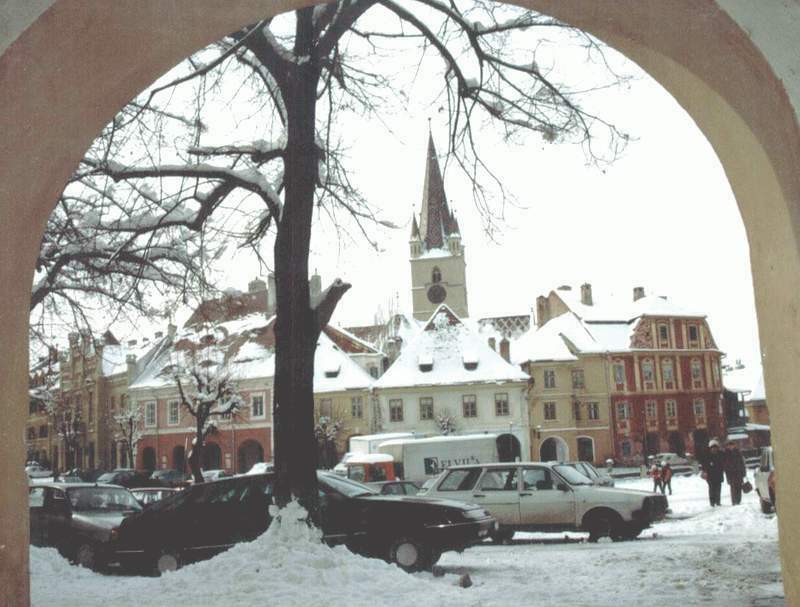
Sibiu Romania, Albert Huet Square, Cafe EinStein,

Sibiu - General Information
Location: Central Romania (County: Sibiu)
Size: 46.7 sq. miles (121 sq. kilometers)
Elevation: 1,410 ft. (430 meters)
Population: 170,000
Inhabited since: 300 BC
First documented: 1191 AD

Sibiu (Hermannstadt in German) was the largest and wealthiest of the seven walled citadels* built in the 12th century by German settlers known as Transylvanian Saxons. The riches amassed by its guilds paid for the construction of both impressive buildings and the fortifications required to protect them.

Sibiu’s Old Town retains the grandeur of its earlier days when rich and powerful guilds dominated regional trade. Like Sighisoara and Brasov, it has a distinctly Germanic feeling. Sections of the medieval wall still guard the historic area, where narrow streets pass steep-roofed 17th century buildings with gable overhangs before opening into vast, church-dominated squares such as Great Square and Little Square.
Sibiu is a pedestrian-friendly city with two easily accessible levels: the Upper town, home to most of Sibiu's historic sights, and the Lower town, lined with colorful houses on cobblestone streets and bounded by imposing city walls and defense towers overlooking the river Cibin.

Traditionally, the Upper town was the wealthier part and commercial outlet, while the Lower town served as the manufacturing area. The historical centre includes the Great Square, Huet Square, the beautiful Passage of Steps connecting the upper town to the lower town, the well-known Bridge of Lies, Goldsmiths’ Square and the Small Square.

In 1797, Samuel von Hahnemann opened in Sibiu the world's first homeopathic laboratory

Sibiu is home to the first hospital in Romania (1292), the first pharmacy (1494) and the oldest museum in Romania, the Brukenthal Museum, opened in 1817

The first book in the Romanian language was printed in Sibiu in 1544


"A journey of a thousand miles must begin with a single step." -- Lao Tzu
Copyright © Demetrios the Traveler


Digg!


Monday, April 27, 2009

Romania ...tara mea

mogosaia

mogosaia

fagaras Posted by Picasa


sibiu

sibiu altstad

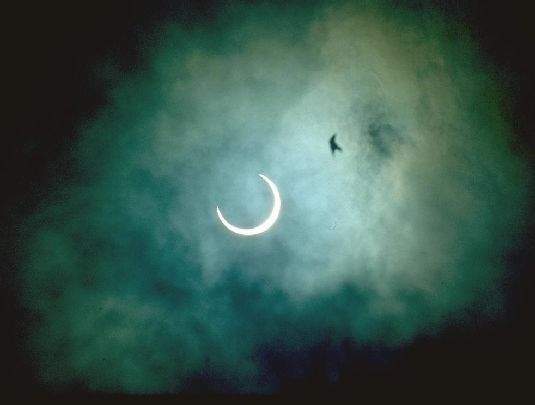
eclipsa totala

"A journey of a thousand miles must begin with a single step." -- Lao Tzu
Copyright © Demetrios the Traveler


Digg!


Friday, June 20, 2008

Bran Castle ...Oχυρο Bran, το "κάστρο του Δράκουλα"


Eυρέως γνωστό σαν το « κάστρο του Dracula», το Bran Castle χτίστηκε αρχικά σαν οχυρό από τους Τεύτονες ιππότες το 1212. Η πρώτη αναφορά για το κάστρο, είναι το διάταγμα που εκδίδεται από το Louis I της Ουγγαρίας, στις 19 Νοεμβρίου 1377, που δίνει στους Σάξονες του Kronstadt (σημερινού Braşov), την άδεια για να χτίσουν την ακρόπολη στο Bran.
Το κάστρο λειτούργησε αρχικά το 1378, σαν οχυρό για προστασία από τις επιθέσεις των Τούρκων και αργότερα σαν τελωνειακός σταθμός στο πέρασμα των βουνών μεταξύ της Τρανσυλβανίας και της Βαλλαχίας.
Εκτός από τη μοναδική αρχιτεκτονική του, το κάστρο έγινε διάσημο μετά από την δημοσίευση του βιβλίου «Ο Κόμης Δράκουλας», του Ιρλανδού συγγραφέα Bram Stocker. Σύμφωνα λοιπόν με την μυθοπλασία, εδώ ήταν η κατοικία του «βρικόλακα των Καρπάθιων». Ο ιστορικός Δράκουλας ο Vlad Ţepeş, δεν έζησε ποτέ στο κάστρο εκτός από ένα διήμερο πέρασμα από τα μπουντρούμια του οχυρού.


"A journey of a thousand miles must begin with a single step." -- Lao Tzu
Copyright © Demetrios the Traveler


Digg!


readers

labels and tags

Powered By Blogger